
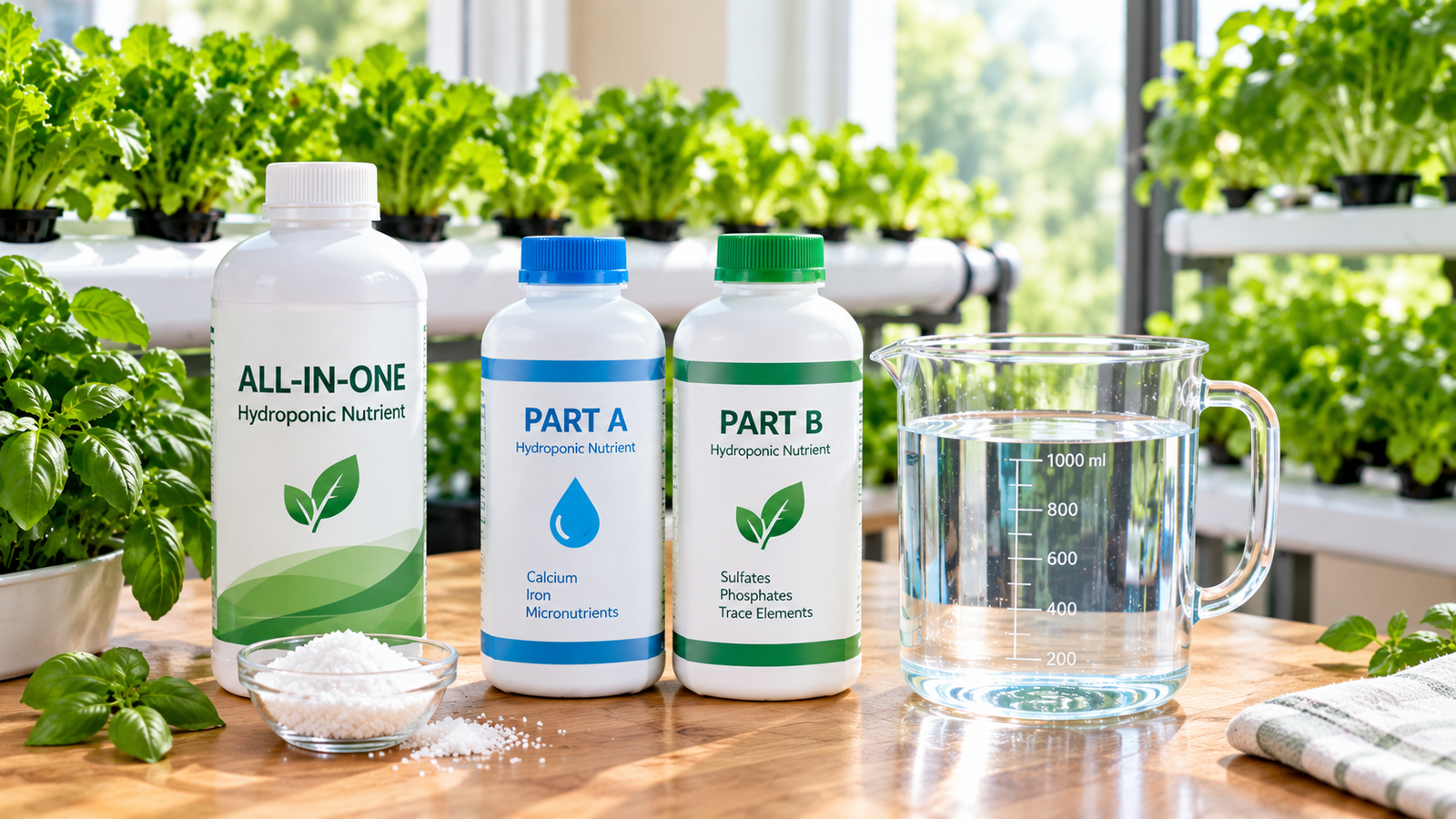
Walk into a hydroponic store and you’ll quickly find bottles promising simple, all-in-one nutrition for your plants. The idea sounds appealing: add one product to your reservoir, stir, and let your plants grow.
But hydroponics depends on chemistry as much as it depends on gardening.
When essential minerals interact in concentrated liquid form, some can react with one another and become unavailable to plants. This can lead to symptoms such as yellow leaves, mineral buildup, and stalled growth even when your reservoir appears to contain plenty of fertilizer.
In this guide, we’ll look at why concentrated single-part formulas can create problems, what nutrient lockout means, and why two-part or dry soluble nutrient systems are commonly used instead.
Why Are Hydroponic Nutrients Different From Soil Fertilizers?
In soil, minerals exist within a larger growing environment that can store and buffer nutrients.
Hydroponic growing is different because the roots depend heavily on minerals dissolved in the water reservoir. This means the chemical balance of the nutrient solution becomes especially important.
What Nutrients Do Plants Need?
Plants require a range of essential elements.
Three important nutrients highlighted in the source are:
- Calcium, which contributes to cell walls and root structures
- Sulfates, which support enzyme production and protein synthesis
- Phosphorus, which plays an important role in root development and flowering
The challenge is not simply supplying these elements. They also need to remain available in a form the plant roots can absorb.
Why Can Calcium and Sulfates Become a Problem?
Concentrated calcium and sulfate cannot safely remain together at high concentrations in a single liquid mixture.
According to the source, they can react and form calcium sulfate, producing a white solid sediment rather than remaining dissolved in the solution. Once minerals precipitate, they are no longer readily available to the plant roots.
What Does This Mean for Your Plants?
A reservoir can appear to contain plenty of nutrients while the plant is still experiencing a deficiency.
This is one reason nutrient problems can be confusing in hydroponics: the issue may not be the total amount of fertilizer, but whether the nutrients remain available to the roots.
Why Do Some Single-Part Nutrients Struggle?
The document identifies several limitations of concentrated single-part liquid formulas.
They May Need Heavy Dilution
To prevent reactive minerals from precipitating inside the bottle, manufacturers may reduce the concentration of minerals and add more water.
The result can be a convenient product that is less concentrated than a grower expects.
They May Leave Out Certain Minerals
Some formulas may leave out calcium or magnesium and assume the grower’s water already contains enough.
This can become particularly important when using reverse osmosis water or naturally soft water with low mineral content.
Plant Needs Change During Growth
A plant does not require exactly the same nutrient balance throughout its life.
Vegetative plants may have a greater demand for nitrogen, while flowering and fruiting plants require a different nutritional balance.
A single static formula may therefore be less flexible than a nutrient program designed around plant development.
What Is the Better Alternative?
The source describes two main approaches for hydroponic growers.
Option 1: Two-Part Liquid Nutrients
A two-part nutrient system keeps reactive minerals separated until they are diluted in the reservoir.
Part A can contain calcium and iron, while Part B can contain sulfates, phosphates, and trace minerals.
The important point is mixing order.
Add Part A to the reservoir first and dilute it thoroughly. Only then should Part B be added.
Option 2: Dry Soluble Nutrients
Dry nutrient powders provide another approach.
Because the ingredients are kept dry, reactive minerals are not suspended together in a concentrated liquid. The source also notes that dry soluble nutrients can be economical and chemically stable when prepared correctly.
What Is Nutrient Lockout?
Nutrient lockout occurs when nutrients are present but the plant cannot effectively absorb them.
The source associates nutrient lockout with factors such as incorrect pH and chemical binding. Symptoms may include yellowing leaves, brown spots, and slowed growth.
Why Adding More Fertilizer Can Make Things Worse
When a plant looks deficient, adding more fertilizer may seem like the obvious solution.
But if the original problem is nutrient precipitation or another form of lockout, adding more nutrients may not solve it.
The better approach is to look at the chemistry and root environment first.
Frequently Asked Questions
Can I mix Part A and Part B together before adding them to the reservoir?
No. The source specifically advises against mixing concentrated Part A and Part B directly because this can trigger precipitation. Add Part A to the water first, dilute it, and then add Part B.
Can single-part nutrients ever work?
The document notes that some single-part products can work temporarily for fast-growing, lower-demand leafy greens such as lettuce or basil, particularly during short growing cycles. It presents greater risks for long-term crops and fruiting plants.
What causes nutrient lockout?
The source identifies incorrect pH and chemical binding as two possible causes.
Are two-part nutrients always better?
The source presents two-part systems as a practical solution to keeping reactive minerals separated, but the correct choice still depends on the crop, water, and growing system.
Final Thoughts
Hydroponic nutrients are not simply about adding more fertilizer.
Successful feeding depends on keeping nutrients soluble, available, and appropriate for the plant’s stage of growth. A two-part liquid system or a properly prepared dry nutrient formula can help growers manage these challenges more effectively.
Next to read: Learn how to choose the right hydroponic nutrient formula and avoid common feeding mistakes.