
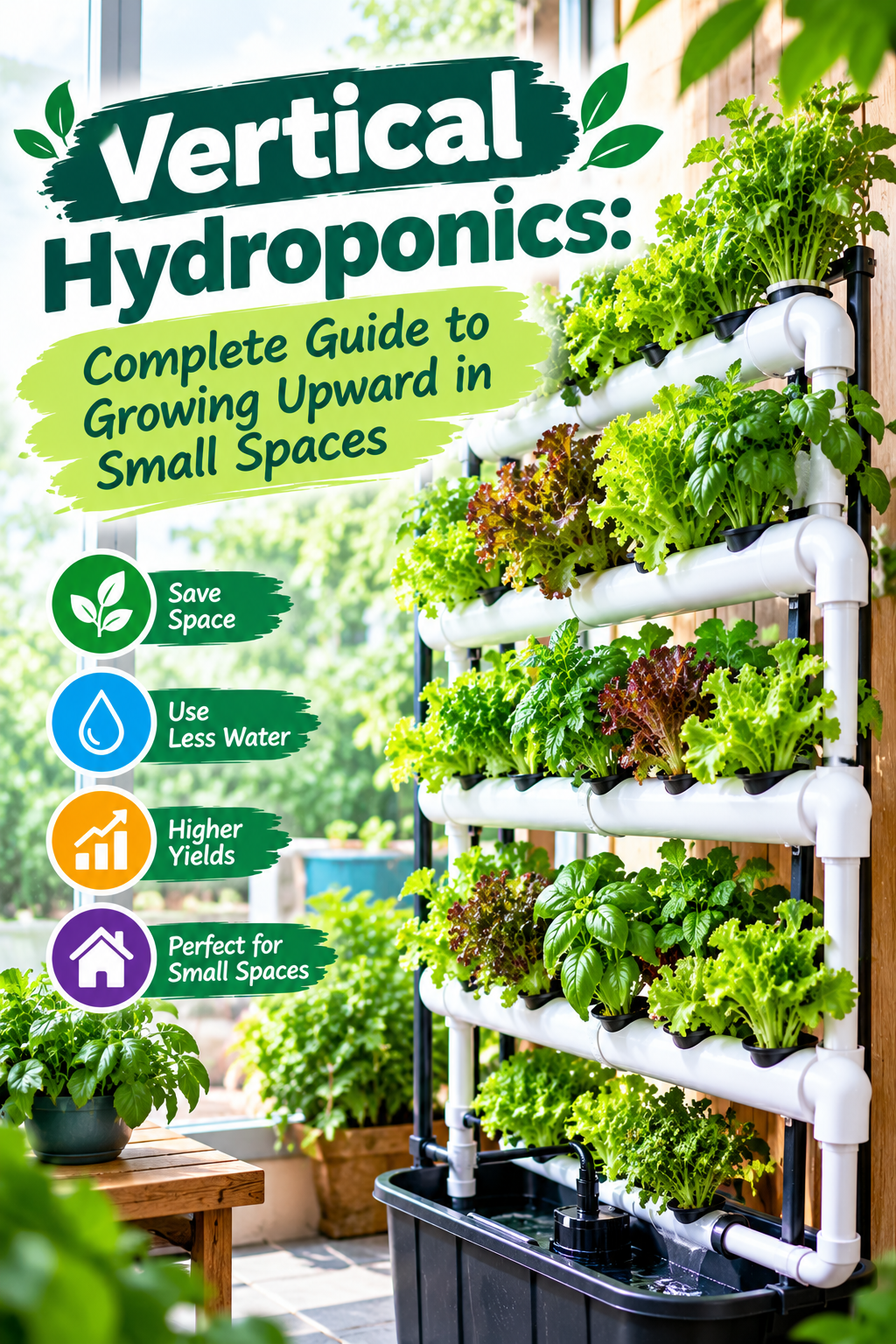
Vertical hydroponics arranges plants in towers, stacked levels, wall panels, or other upright structures to make better use of limited floor space. Unlike DWC or NFT, vertical hydroponics is not a single irrigation technique. A vertical structure may use drip irrigation, NFT-style channels, or another method. The key idea is to grow upward while keeping water delivery, lighting, access, and structural safety under control.
Table of Contents
- Introduction: What Is Vertical Hydroponics?
- How Does a Vertical Hydroponic System Work?
- Hydroponic Tower Setup
- Best Plants for Vertical Hydroponics
- Indoor Vertical Hydroponics and Lighting
- Advantages and Challenges
- How to Choose and Maintain a Vertical System
- FAQ: Vertical Hydroponics
What Is Vertical Hydroponics?
Vertical hydroponics combines soilless plant production with a vertical layout. Instead of placing every plant across a single horizontal surface, growers use height to increase planting positions within a limited footprint. Towers and stacked systems are especially useful for balconies, indoor gardens, greenhouses, and urban growing projects where floor space is scarce.
How Does a Vertical Hydroponic System Work?
The irrigation method depends on the design. A tower may deliver nutrient solution from the top so it flows downward through plant sites. A stacked rack may use NFT channels, while another structure may use individual drip emitters. The important requirement is even delivery: plants at different heights should receive suitable water and nutrients without creating excessive pooling, leakage, or dry areas.
Key Terms Beginners Should Know
- Nutrient solution: water mixed with the mineral nutrients required by the crop.
- Root zone: the area where roots receive water, nutrients, and oxygen.
- Growing medium: an inert or low-nutrient material used to support plants in some systems.
- Reservoir: the container that holds nutrient solution in many hydroponic designs.
- Recirculating system: a setup in which solution is collected and used again.
Hydroponic Basics to Remember
Whatever hydroponic system you choose, plants still need the fundamentals: suitable light, water, mineral nutrients, oxygen around the root zone, an appropriate temperature, and regular observation. Hydroponics changes how water and nutrients reach the roots; it does not remove the need for good plant care. Indoor growers may need grow lights and ventilation, while greenhouse and outdoor growers must consider heat, sunlight, seasonal changes, and reservoir temperature.
Hydroponic Tower Setup
A vertical hydroponic tower usually needs a stable structure, reservoir, pump, tubing, plant sites, and a return path. Before planting, test the flow from the top to the bottom. Make sure the reservoir is accessible for cleaning and that the tower can support the weight of water and mature plants. Plan how you will reach every planting site for harvesting, pruning, inspection, and repairs.
Step-by-Step Beginner Checklist
- Clean the reservoir, containers, irrigation parts, and tools before use.
- Choose a crop that matches the system and available space.
- Prepare nutrient solution according to the nutrient manufacturer’s directions.
- Check pH and, when appropriate, EC or TDS before planting.
- Test water delivery, drainage, aeration, or spray performance before adding a full crop.
- Plan how you will respond to a pump, timer, power, or irrigation failure.
pH and EC in Hydroponics
pH influences how readily plants can access nutrients, while electrical conductivity (EC) indicates the overall concentration of dissolved salts in the solution. There is no single pH or EC number that is correct for every plant or growth stage. Follow the nutrient manufacturer’s directions and learn the needs of the crop you are growing. Measure consistently rather than making large changes based on guesswork.
Best Plants for Vertical Hydroponics
Compact leafy greens and herbs are common choices because they fit tightly spaced systems. Lettuce, basil, and similar crops can be practical when light and nutrient distribution are adequate. Strawberries and other compact crops can also be considered in appropriate designs. Large plants may be difficult because their canopy, root mass, and support requirements can overwhelm a tightly packed vertical structure.
Choosing Plants for Your Setup
Crop selection should consider root size, plant height, water demand, harvest time, and the amount of support required. Compact leafy greens and herbs are usually easier for first experiments because they have modest structural demands. Larger fruiting plants need more space, stronger support, and a more controlled supply of water and nutrients.
Water Quality and Root Health
Clean water and clean equipment are central to reliable hydroponic growing. Keep reservoirs, tools, containers, and irrigation components clean. Watch for algae, unusual odors, slimy roots, clogged emitters, blocked channels, or sudden uneven growth. Root problems can develop quickly when oxygen, temperature, moisture, or sanitation are poorly controlled. A simple maintenance routine often prevents more problems than adding expensive equipment.
Indoor Vertical Hydroponics and Lighting
Growing vertically indoors changes the lighting challenge. Plants on different levels or sides of a tower may receive different amounts of light. Supplemental grow lights can therefore be important. Airflow and temperature also need attention because dense plant arrangements can reduce ventilation. The goal is not simply to maximize the number of plant sites; it is to create a usable root and canopy environment.
Benefits for Home Growers
A well-matched hydroponic system can make indoor or small-space growing more organized. Recirculating designs can reuse nutrient solution, while compact layouts can fit a balcony, spare room, greenhouse bench, or grow tent. These advantages should be balanced against equipment, electricity, monitoring, cleaning, and the possibility of rapid crop stress after a system failure.
Hydroponics at Home
Home hydroponics can be as simple as a passive container or as structured as a recirculating indoor garden. The best system is not necessarily the most advanced. Think about your available space, crop, budget, electricity, lighting, and the amount of time you can spend checking the garden. Beginners often learn faster by starting with a small system, one or two crops, and a clear maintenance routine.
Advantages and Challenges
The main benefit is better use of floor space. A vertical hydroponic garden can increase planting positions without requiring a larger footprint. However, vertical systems introduce new challenges: uneven light, uneven irrigation, difficult access, structural load, drainage, and cleaning. A crowded tower can look productive while actually making plant care harder. Good design leaves enough access for routine maintenance.
Common Problems and Troubleshooting
- Uneven growth can indicate inconsistent water or nutrient delivery, light differences, or root problems.
- Algae is encouraged by light reaching nutrient solution, so opaque reservoirs and clean equipment are useful.
- Clogged irrigation parts can create major differences between plants; inspect filters, tubing, channels, or nozzles.
- Root problems can be linked to poor oxygenation, unsuitable temperature, excessive moisture, or sanitation issues.
- Rapid wilting after equipment failure is a warning to check pumps, timers, power, and flow immediately.
How to Choose the Right System
Choose the system around the plant rather than choosing the plant around a fashionable system. Leafy greens and herbs often fit DWC, NFT, Kratky, or wick setups. Larger fruiting crops generally benefit from controlled drip irrigation and a suitable substrate. Ebb and flow offers flexibility for trays and pots, while vertical layouts can solve space problems. Aeroponics can provide a highly controlled root environment but demands more attention to pumps, filters, nozzles, and reliability.
How to Choose and Maintain a Vertical System
Before building, define the crop, available floor area, light source, water supply, and maintenance routine. Check that the pump can deliver solution to the highest point and that the return line drains freely. Inspect each level for leaks and uneven growth. For beginners, start with a small vertical hydroponic tower rather than a complex multi-level farm. A manageable system is easier to learn, clean, and improve.
FAQ
Is this hydroponic system good for beginners?
It can be, provided the setup matches the crop and the grower is prepared to monitor the basic conditions. Simpler systems are often easier to understand and maintain.
Does hydroponics require electricity?
Some systems are passive and do not require a powered water pump, while active systems commonly use pumps, timers, or aeration. Indoor gardens may also require supplemental lighting.
What should I monitor?
At minimum, monitor plant condition, water level, cleanliness, and the reliability of the system. pH and nutrient strength are also important for nutrient management.
What is the biggest beginner mistake?
A common mistake is choosing equipment before considering the crop and maintenance routine. Start with a manageable design and learn how the root environment behaves.
Final Takeaway
Vertical Hydroponics can be a valuable part of a home or commercial hydroponic garden when its strengths and limitations are understood. Focus on the basics, keep the system clean, monitor plants consistently, and scale only after the first setup is reliable.