
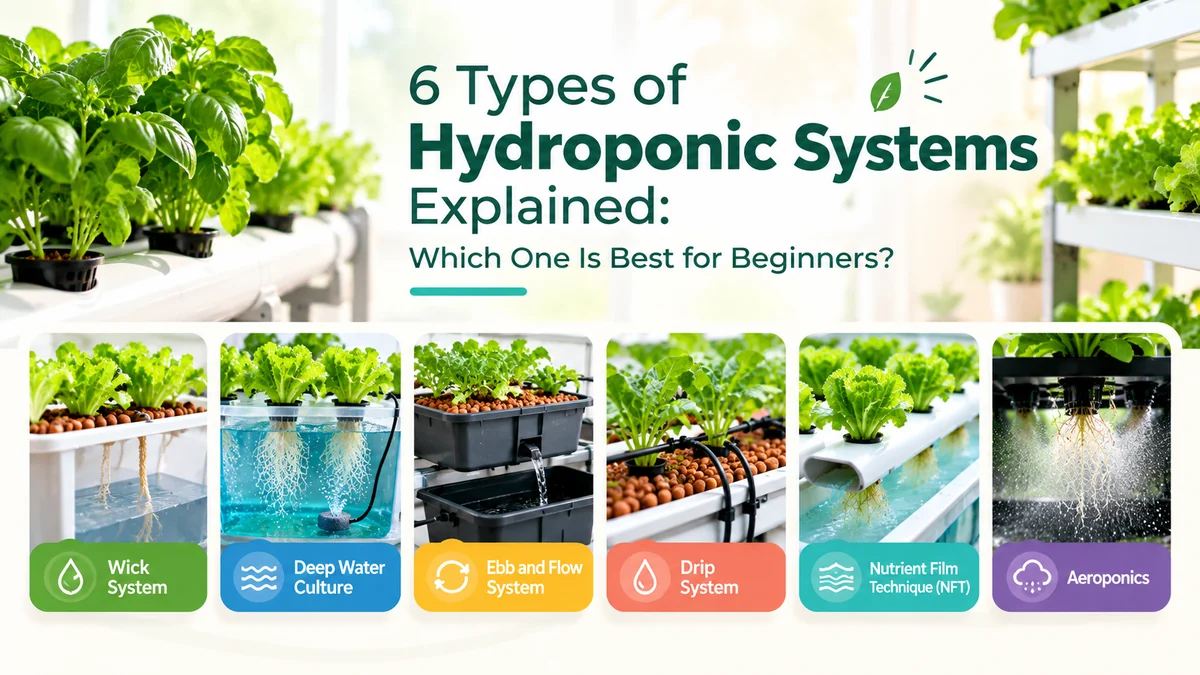
One of the first decisions you’ll make when starting hydroponics is choosing the right growing system.
There isn’t just one way to grow plants hydroponically. Some systems are simple and require very little equipment, while others use pumps, timers, tubing, and continuous water circulation.
Understanding the different types of hydroponic systems can help you choose one that matches your experience level, available space, budget, and the plants you want to grow.
Let’s look at six popular hydroponic systems and how they work.
1. Wick System
The wick system is one of the simplest types of hydroponic systems.
It uses an absorbent wick to transport water and nutrients from a reservoir to the growing medium and plant roots.
How Does a Wick System Work?
The system generally includes:
- A reservoir
- A growing container
- A growing medium
- One or more wicks
The wick absorbs the nutrient solution and slowly carries it upward toward the plant roots.
Advantages of the Wick System
The wick system is popular with beginners because:
- It is simple to build
- It has few moving parts
- It can operate without electricity
- It requires no complicated pump system
Limitations of the Wick System
Large plants may require more water and nutrients than a wick can deliver.
For this reason, lighter-feeding plants such as herbs and leafy plants are generally better suited to this type of system.
2. Deep Water Culture System
Deep Water Culture is one of the simplest water-based hydroponic methods.
Plant roots grow directly in nutrient-rich water.
How Does Deep Water Culture Work?
Plants are placed above a reservoir.
Their roots extend downward into the nutrient solution.
An air pump and air stone are used to create bubbles and improve oxygen availability around the roots.
Best Uses
This type of system can be suitable for certain smaller plants, including leafy vegetables such as lettuce.
3. Ebb and Flow System
The Ebb and Flow system is also known as a flood-and-drain system.
It periodically delivers nutrient solution to the growing area before allowing the water to drain back into the reservoir.
How Does It Work?
A pump moves nutrient solution from the reservoir into the growing tray.
The plants receive water and nutrients before the solution drains back.
A timer can control when the flooding and draining process happens.
Advantages
The system can be flexible and adaptable.
It can also be used in different designs depending on the available materials and growing goals.
Important Maintenance
Cleaning is important because algae can develop when parts of the system are exposed to light and moisture.
Regular maintenance helps keep the growing environment healthier.
4. Drip System
Drip systems deliver nutrient-rich water to plants through small tubes.
The nutrient solution is directed toward the root area.
How Does a Drip System Work?
A pump moves water from the reservoir through tubing.
The solution is then delivered to individual plants through smaller drip lines.
Timers can be used to control the watering schedule.
Why Choose a Drip System?
Drip systems allow growers to control how water and nutrients are delivered to individual plants.
They can be adapted for different growing arrangements and plant types.
5. Nutrient Film Technique (NFT)
The Nutrient Film Technique is commonly known as NFT.
This system uses a shallow and continuous flow of nutrient solution.
How Does NFT Work?
Plants are placed in growing channels.
Their roots come into contact with a thin flow of nutrient-rich water.
The excess solution returns to the reservoir and can be reused.
Plants Commonly Associated With NFT
NFT systems are commonly used for:
- Lettuce
- Baby greens
- Herbs
The system creates a continuous flow of nutrients around the root area.
6. Aeroponics
Aeroponics is a more advanced growing method.
Instead of placing plant roots in a growing medium or continuously submerging them in water, the roots are suspended and regularly misted with water and nutrients.
How Does Aeroponics Work?
The plant roots remain exposed to air.
A system delivers a fine mist of nutrient solution directly to the roots.
Advantages
The roots have access to both air and nutrients.
However, aeroponic systems generally require more equipment and careful management than simple beginner systems.
How Do You Choose the Right Hydroponic System?
The best hydroponic system depends on several factors.
Your Experience Level
Beginners may prefer a wick system or another simple setup.
Your Budget
Simple passive systems usually require less equipment than advanced systems with pumps and timers.
Your Available Space
Compact systems may work better in apartments or small indoor areas.
The Plants You Want to Grow
Different plants have different water and nutrient requirements.
Before choosing a system, think about what you want to grow.
Which Hydroponic System Is Best for Beginners?
For many beginners, the wick system is an excellent starting point.
It is simple and helps new growers understand the relationship between:
- Water
- Nutrients
- Roots
- Growing media
After gaining experience, growers can explore systems such as Deep Water Culture, NFT, drip systems, or Ebb and Flow.
Frequently Asked Questions
What is the easiest hydroponic system?
The wick system is generally one of the easiest because it has no complicated moving parts and can work without pumps.
Which hydroponic system does not need electricity?
A basic wick system can operate without electricity because it uses capillary action to move water and nutrients.
Which system is best for lettuce?
The guide discusses water culture and Nutrient Film Technique systems as suitable options for leafy plants such as lettuce and greens.
Which hydroponic system is the most advanced?
Aeroponics generally requires more technical equipment and management because nutrients are delivered through misting systems.
Final Thoughts
There are many types of hydroponic systems, and each one works differently.
Beginners should avoid making their first project unnecessarily complicated. A simple system can teach you the fundamentals before you invest in more advanced equipment.
Start with your available space, budget, and preferred plants, then choose the system that best fits your situation.
Next to read: Learn about the benefits of hydroponics or follow our step-by-step guide on starting a DIY hydroponic garden at home.