
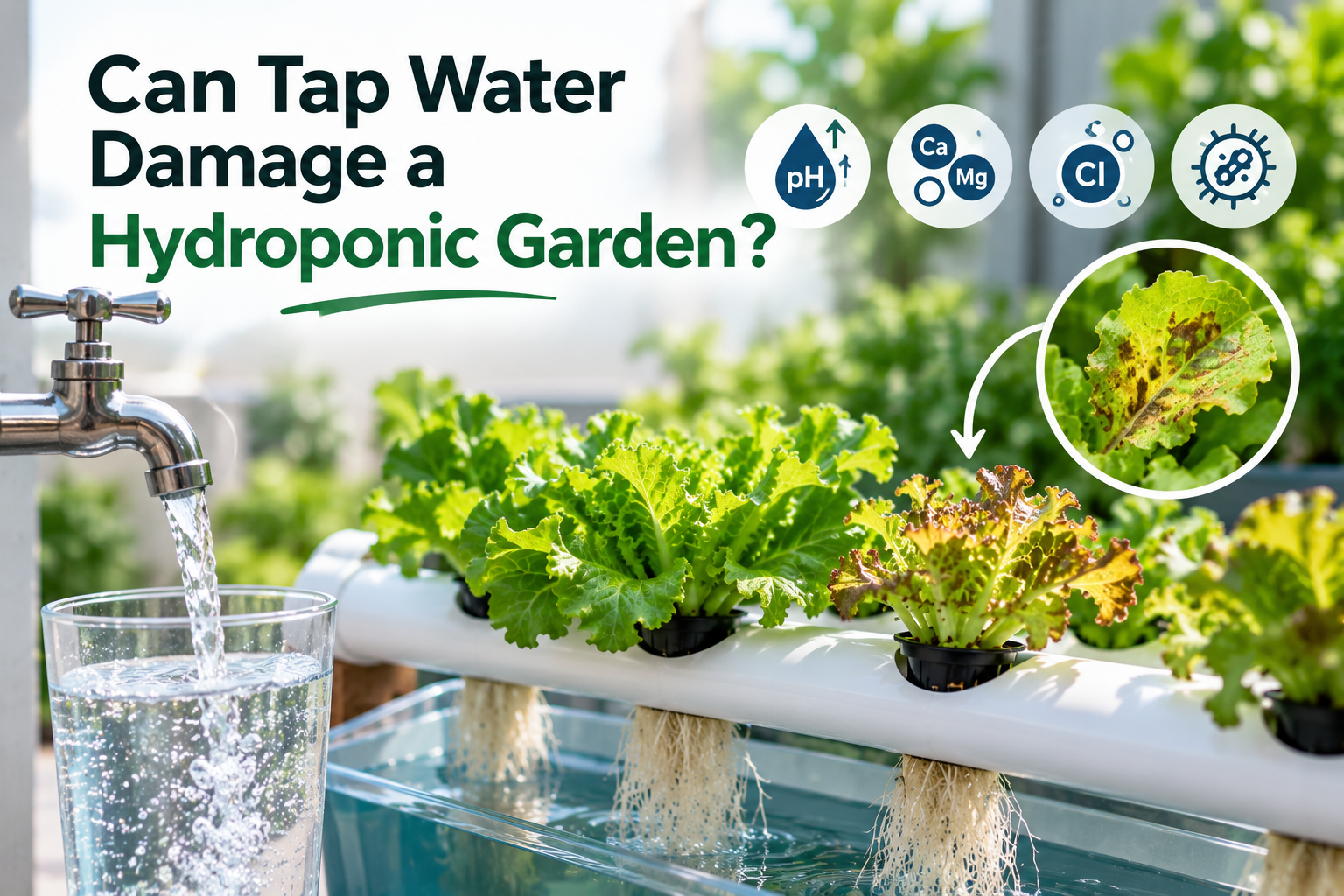
Tap water is not automatically harmful to hydroponic plants, but its chemistry varies by location and can influence nutrient management. Water can contain calcium, magnesium, bicarbonate, salts, and other dissolved substances. Its alkalinity can affect pH stability, while a high starting EC can reduce the room available for hydroponic nutrients. The right question is not whether tap water is good or bad in general, but whether the particular water source is suitable for the crop and nutrient program.
Table of Contents
- Why This Topic Matters
- What You Need Before You Start
- Understanding Hydroponic Systems
- Step-by-Step Guide
- Light, Water, Nutrients and Environment
- Common Mistakes to Avoid
- Troubleshooting
- Maintenance and Recovery
- Frequently Asked Questions
- Topic-Specific Questions
- Internal Linking Opportunities
- Final Tips
Why This Topic Matters
Hydroponics gives growers direct control over the root-zone solution, so starting water matters. If the source already contains substantial minerals, adding a complete nutrient formula can push EC higher than intended. If alkalinity is high, pH may also resist downward adjustment and drift upward over time.
What You Need Before You Start
- A pH meter or reliable pH test method
- An EC meter
- Information about local water quality when available
- Complete hydroponic nutrients
- Clean containers for mixing
- A consistent water source for repeatable results
- A water-treatment option when testing shows it is necessary
Understanding Hydroponic Systems
DWC
The reservoir chemistry is directly connected to the root environment, so source-water characteristics can have a noticeable effect.
NFT
Because solution recirculates, dissolved minerals accumulate if plants consume water faster than certain ions or if top-ups are not managed carefully.
Media-based systems
The root-zone solution still depends on irrigation water quality, even though the medium provides physical support.
Passive systems
The same source-water chemistry applies; lower-tech equipment does not remove mineral or pH effects.
The best setup is the one that matches the crop, available space, expected maintenance, and the grower’s ability to monitor the system. A simpler design is often easier to troubleshoot because fewer components can fail at the same time.
Step-by-Step Guide
1. Test the source water
Measure EC and pH, and review alkalinity or water-quality information if available.
2. Compare the result with your nutrient plan
A complete nutrient formula assumes something about the starting water. High mineral content may change the final solution.
3. Mix carefully
Add nutrients according to the product instructions and mix thoroughly before making final measurements.
4. Monitor pH
Add nutrients according to the product instructions and mix thoroughly before making final measurements.
5. Watch plant response
Observe how stable the solution remains instead of adjusting pH repeatedly without understanding the source.
6. Watch plant response
Look for consistent patterns in leaf condition, growth, and root health rather than reacting to one isolated symptom.
7. Change the water source only when justified
If testing shows the source is unsuitable, consider filtration, reverse osmosis, blending, or another appropriate water source.
Light, Water, Nutrients and Environment
Tap-water quality can change over time or between locations. Water treatment at the municipal level also varies. For that reason, a hydroponic grower should avoid assuming that advice about tap water from another city applies exactly to their own source. A water report or simple measurements can provide much more useful information.
Light
Light should be managed according to the crop and the growing location. Indoor growers should distinguish between a room that looks bright and a location that provides enough usable light for photosynthesis. Outdoor or window gardens also need protection from excessive heat.
Water and Oxygen
Water availability and root-zone oxygen are connected to system design. Active circulation, aeration, reservoir temperature, and the amount of exposed root surface all influence the root environment. Do not treat water quantity alone as proof that roots are healthy.
Nutrients and pH
Use a complete hydroponic nutrient program appropriate for the crop. Measure the solution rather than making repeated adjustments based only on appearance. pH and EC are useful management tools, but they should be interpreted together with plant growth and water conditions.
Common Mistakes to Avoid
- Assuming all tap water has the same chemistry
- Ignoring starting EC
- Focusing only on pH and ignoring alkalinity
- Adding nutrients before measuring the source
- Making repeated pH corrections without checking the underlying water quality
Troubleshooting
EC is high before nutrients are added
The source water already contains dissolved minerals. Check the water quality and consider whether treatment is needed.
pH keeps rising
High alkalinity can contribute to pH drift. Investigate the source rather than repeatedly adding acid without understanding the cause.
Leaf tips burn
High alkalinity can contribute to pH drift. Investigate the source rather than repeatedly adding acid without understanding the cause.
Leaf tips burn
Check EC and the complete nutrient concentration before assuming a disease.
Plants show inconsistent deficiencies
Review pH, source-water composition, nutrient compatibility, and root-zone conditions together.
Maintenance and Recovery
If tap water is working well, there is no reason to change it simply because another grower uses filtered water. Consistency is valuable. Continue testing and record the results so you can detect changes in the source.
A good maintenance routine is preventive. Check the root zone, reservoir level, equipment, plant structure, and growing environment at regular intervals. Record unusual observations so you can identify patterns instead of treating every problem as a new mystery.
Frequently Asked Questions
Can I use tap water directly for hydroponics?
Often yes, if its quality is appropriate. Testing EC, pH, and available water-quality information helps determine suitability.
Is high-EC tap water a problem?
It can reduce the room available for added nutrients and may increase the risk of excessive dissolved salts.
Does tap water affect pH?
Yes. Water chemistry, especially alkalinity, can influence pH behavior and stability.
Should I use reverse osmosis water?
It can be useful when source water has undesirable mineral or salt characteristics, but it is not automatically necessary for every hydroponic garden.
Topic-Specific Questions
Different crops tolerate nutrient concentrations differently, so the same tap water can be easier to manage for one crop than another. Always combine source-water information with the nutrient requirements of the crop being grown.
When applying this advice to a specific crop, consider plant age, canopy size, root volume, and the crop’s preferred environmental conditions. A young herb and a mature fruiting plant can respond very differently to the same change in water, temperature, or light.
Practical Takeaway
The most reliable hydroponic routine is based on observation and measurement. Keep the system stable, learn what is normal for your crop, and investigate changes before making large corrections. This approach makes hydroponics more predictable and easier to maintain over time.
Internal Linking Opportunities
- Can You Grow Hydroponically Using Rainwater?
- Can Hydroponics Work During a Heatwave?
- What Happens If You Forget to Check Your Hydroponic Garden for a Week?
Final Tips
- Match the hydroponic method to the crop and the level of maintenance you can provide.
- Measure important variables instead of relying only on visual symptoms.
- Keep equipment clean and inspect pumps, tubing, reservoirs, and timers regularly.
- Make one controlled change at a time when troubleshooting.
- Record useful observations so future problems are easier to diagnose.
[…] Can Tap Water Damage a Hydroponic Garden? […]
[…] Can Tap Water Damage a Hydroponic Garden? […]
[…] Can Tap Water Damage a Hydroponic Garden? […]
[…] Can Tap Water Damage a Hydroponic Garden? […]
[…] Can Tap Water Damage a Hydroponic Garden? […]
[…] Can Tap Water Damage a Hydroponic Garden? […]