
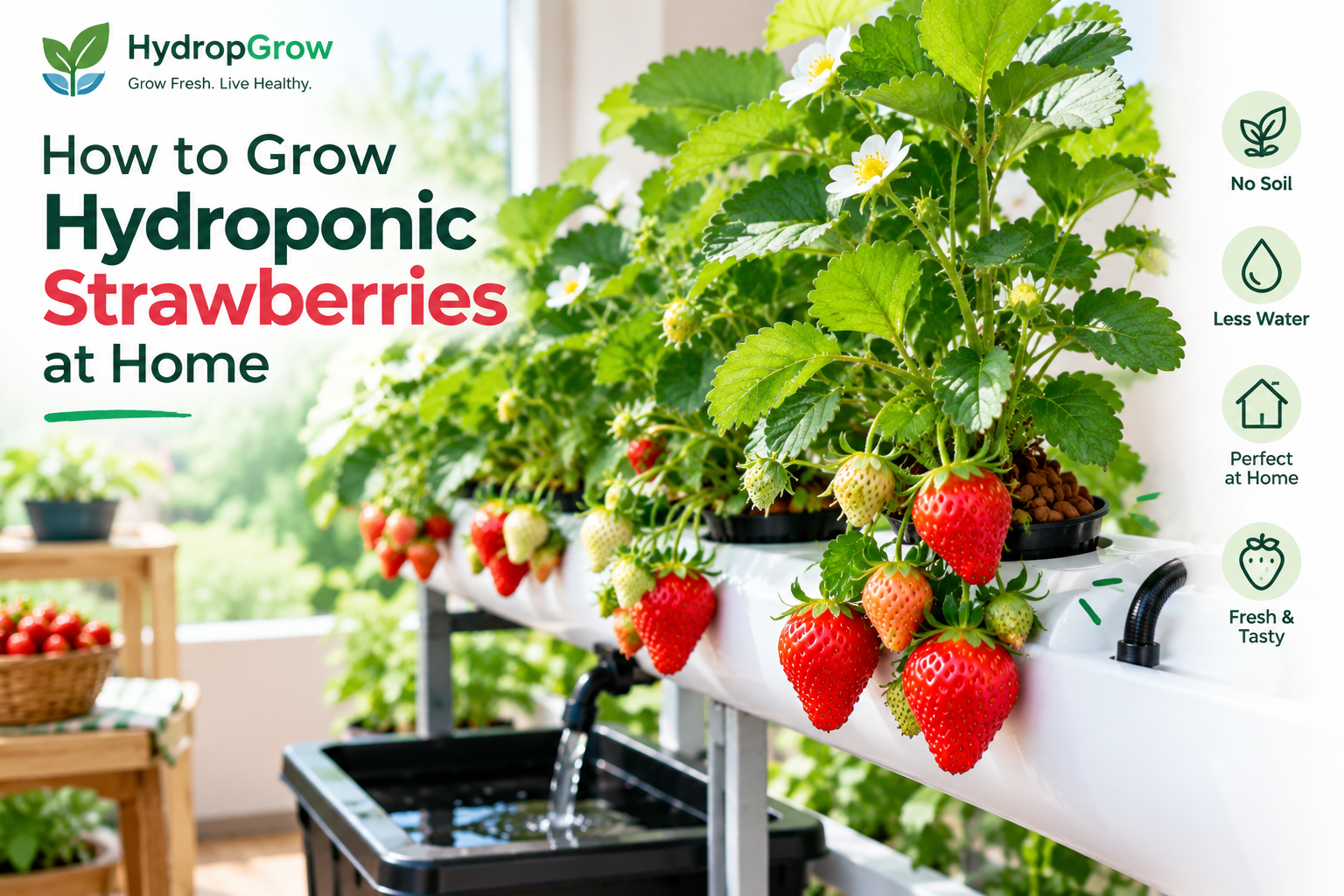
Hydroponic strawberries are a practical choice for growers who want fresh fruit in a small controlled environment. Strawberries have a relatively compact growth habit compared with many fruiting vegetables, making them suitable for several hydroponic systems. Success depends on healthy plants, clean roots, adequate light, careful nutrition, good airflow, and effective pollination. This guide takes you from selecting plants through harvesting ripe berries.
Table of Contents
- Why Grow This Crop Hydroponically
- What You Need
- Choosing the Right Hydroponic System
- Step-by-Step Growing Guide
- Light, Water, Nutrients and Environment
- Common Mistakes
- Troubleshooting
- Harvesting and Maintenance
- Frequently Asked Questions
- Final Tips
Why Grow This Crop Hydroponically?
Growing hydroponic strawberries hydroponically gives the grower more control over the root environment than conventional soil gardening. Instead of relying on the physical and chemical properties of garden soil, the grower can manage water delivery, nutrient availability, oxygen around the roots, and the cleanliness of the growing area. This can be particularly useful indoors, on balconies, in greenhouses, or in other places where traditional garden space is limited.
Hydroponics is not a shortcut that removes every gardening challenge. Plants still need the correct genetics, light, temperature, air movement, nutrients, and time. The advantage is that many variables can be observed and adjusted more directly. For beginners, the best approach is to start with a manageable system, learn how the plant responds, and then scale up.
What You Need Before You Start
- A clean reservoir, container, or hydroponic growing system
- Net pots or another reliable way to support plants
- An inert growing medium suitable for hydroponics
- Complete hydroponic nutrients
- pH testing equipment and a way to adjust pH when necessary
- Clean water and a container for mixing nutrients
- A suitable grow light when natural light is insufficient
- Airflow appropriate for the size of the growing area
- Trellis, clips, stakes, or other support for larger fruiting plants when required
- Clean scissors and basic tools for pruning and harvesting
Hydroponics replaces the soil root environment with water, nutrients, oxygen, and a physical support medium. The exact equipment can vary from a passive container to active systems such as DWC, NFT, drip, or media-based systems. For a home grower, simplicity and reliability matter more than buying the most complicated equipment. Choose a system that you can inspect, clean, refill, and troubleshoot easily. Water-based systems such as DWC and NFT are widely used for leafy greens and herbs, while media-based systems are commonly used for larger fruiting crops.
Choosing the Right Hydroponic System
Passive Systems
Passive systems use the plant and the container design to manage water movement without a continuously running pump. They can be useful for small home gardens and beginner experiments, especially with herbs and some leafy greens. Their simplicity makes inspection and maintenance straightforward, but the system still needs a stable root environment.
Deep Water Culture (DWC)
DWC places plant roots in nutrient solution while providing oxygen to the water. It is widely used for leafy greens and herbs, and can also be used for some fruiting crops. Because the roots depend on the water environment, oxygenation, water temperature, and cleanliness are important.
Nutrient Film Technique (NFT)
NFT continuously moves a shallow film of nutrient solution along a growing channel. It is particularly common for lettuce, herbs, and other relatively small crops. A pump failure or blocked flow can quickly affect plants, so reliable circulation and regular inspection matter.
Media-Based Systems
Media-based systems use an inert material to physically support the plant while nutrient solution is delivered to the root zone. They are especially useful for larger fruiting crops such as tomatoes, peppers, cucumbers, and strawberries. The container and irrigation design should allow both moisture and oxygen around the roots.
Step-by-Step Growing Guide
1. Choose healthy plants
Start with disease-free strawberry plants or reputable plugs. Select a compact, productive variety suited to your climate and growing space. Avoid weak plants with damaged crowns or signs of pests.
Begin with a small number of plants so you can observe the crop closely. During this stage, focus on consistency rather than maximum growth. Check the root zone, water level, leaves, and new growth. If a change is needed, make it gradually and record what you changed.
2. Prepare the root zone
Use a clean inert medium that provides support without burying the crown. The crown should remain at the correct height because excessive moisture around it can create problems. Handle roots gently during transplanting.
Begin with a small number of plants so you can observe the crop closely. During this stage, focus on consistency rather than maximum growth. Check the root zone, water level, leaves, and new growth. If a change is needed, make it gradually and record what you changed.
3. Select the hydroponic system
NFT channels, vertical systems, and media-based containers can all be used. Choose a design that allows easy inspection and cleaning. Make sure the system gives roots access to both moisture and oxygen.
Begin with a small number of plants so you can observe the crop closely. During this stage, focus on consistency rather than maximum growth. Check the root zone, water level, leaves, and new growth. If a change is needed, make it gradually and record what you changed.
4. Provide light and airflow
Indoor strawberries need sufficient light for healthy leaves and fruit production. Keep air moving gently around the canopy and avoid creating persistently humid, stagnant conditions.
Begin with a small number of plants so you can observe the crop closely. During this stage, focus on consistency rather than maximum growth. Check the root zone, water level, leaves, and new growth. If a change is needed, make it gradually and record what you changed.
5. Manage nutrients and pH
Use a complete nutrient solution appropriate for fruiting crops. Monitor pH and nutrient strength consistently. Make changes gradually and avoid using garden soil fertilizers that are not designed for hydroponics.
Begin with a small number of plants so you can observe the crop closely. During this stage, focus on consistency rather than maximum growth. Check the root zone, water level, leaves, and new growth. If a change is needed, make it gradually and record what you changed.
6. Encourage flowering and pollination
When flowers appear indoors, pollination may require assistance. Gently brush or move pollen between flowers according to the plant’s flowering pattern. Good airflow can also help.
Begin with a small number of plants so you can observe the crop closely. During this stage, focus on consistency rather than maximum growth. Check the root zone, water level, leaves, and new growth. If a change is needed, make it gradually and record what you changed.
7. Manage runners
Strawberry plants may produce runners. If your priority is fruit, remove unnecessary runners so the plant can focus resources on flowering and fruiting. If you want new plants, selected runners can be rooted separately.
Begin with a small number of plants so you can observe the crop closely. During this stage, focus on consistency rather than maximum growth. Check the root zone, water level, leaves, and new growth. If a change is needed, make it gradually and record what you changed.
8. Harvest ripe fruit
Pick berries when they have developed the expected color and aroma for the variety. Handle fruit gently and avoid leaving overripe berries in the growing area because damaged fruit can attract pests and disease.
Begin with a small number of plants so you can observe the crop closely. During this stage, focus on consistency rather than maximum growth. Check the root zone, water level, leaves, and new growth. If a change is needed, make it gradually and record what you changed.
Light, Water, Nutrients and Environment
Light
Light drives photosynthesis and strongly affects the shape and productivity of hydroponic plants. Indoor growers should choose a grow light appropriate for the crop and follow the manufacturer’s guidance for hanging height and operating schedule. Weak light can produce stretched, thin growth, while excessive light or heat can stress leaves. Watch the plant response rather than relying on distance alone.
Water and Oxygen
Roots need access to both water and oxygen. The exact balance depends on the hydroponic system. In DWC, aeration is especially important. In NFT and well-designed media systems, the shallow flow or drainage helps maintain oxygen around roots. Avoid stagnant conditions and inspect the system regularly for blocked lines, pump problems, leaks, or unusual odors.
Nutrients and pH
Hydroponic plants receive mineral nutrients through the solution rather than through soil. Use a complete hydroponic nutrient product and follow its instructions. Monitor pH and nutrient strength with appropriate tools. Avoid making large corrections based only on leaf color; symptoms can have multiple causes, including root stress, light problems, temperature, or nutrient imbalance.
Temperature and Airflow
Temperature affects root activity, transpiration, flowering, and disease pressure. Different crops have different preferences, so the growing space should be managed according to the crop. Gentle airflow helps reduce stagnant humidity and strengthens stems, but very strong direct airflow can increase water loss and stress tender leaves.
Common Mistakes to Avoid
- Starting with too many plants before learning how the system behaves.
- Changing nutrient strength every day without measuring or recording results.
- Ignoring the root zone because the leaves look healthy.
- Allowing light to reach the nutrient reservoir and encouraging algae.
- Using a variety that becomes too large for the available indoor space.
- Waiting until a fruiting plant is heavy before installing support.
- Overwatering or keeping the crown continuously wet when the crop needs better aeration.
- Ignoring temperature and airflow while focusing only on fertilizer.
Troubleshooting
Small fruit
Review light, pollination, plant age, nutrition, and variety. Poor pollination can lead to misshapen berries.
Soft or damaged berries
Improve airflow, avoid wetting fruit unnecessarily, and remove damaged fruit promptly.
Crown problems
Check planting depth and make sure the crown is not continuously exposed to wet conditions.
Poor flowering
Review light intensity, plant maturity, temperature, and nutrition.
Root browning
Inspect water quality, oxygenation, temperature, cleanliness, and possible root disease.
Harvesting and Long-Term Maintenance
Harvesting is part of crop management, not simply the final step. Regularly harvesting herbs and leafy greens can keep the canopy productive. For fruiting crops, removing ripe fruit prevents the plant from carrying unnecessary weight and allows you to use the available space efficiently. Use clean tools, handle stems gently, and remove damaged plant material from the growing area.
Between crops, clean the reservoir, growing channels, containers, and reusable equipment. Inspect pumps, tubing, net pots, and supports. A clean reset is easier than trying to solve a sanitation problem after the next crop is already established.
Frequently Asked Questions
Can I grow this crop indoors?
Yes. Indoor hydroponics can work when the crop receives adequate light, suitable temperature, airflow, clean water, and enough space for mature growth.
What hydroponic system should a beginner use?
A simple system that matches the crop is usually easiest. Passive or DWC systems can suit many herbs and leafy greens, while larger fruiting plants often benefit from media-based or active systems.
Do I need special nutrients?
Use a complete hydroponic nutrient formulated for the crop or hydroponic vegetables. Follow the manufacturer’s mixing instructions and monitor the solution.
How often should I check pH?
Check it regularly according to the stability of your system and the crop. The important point is to monitor rather than make blind adjustments.
Why are my roots turning brown?
Possible causes include poor oxygenation, excessive heat, contamination, stagnant water, or root disease. Inspect the entire system before deciding on a treatment.
Can I use garden fertilizer?
Standard garden fertilizers are not automatically suitable for hydroponics. A complete hydroponic formulation is generally easier to manage because it is designed for plants growing without soil.
How do I prevent algae?
Limit light reaching the nutrient solution, keep containers clean, remove plant debris, and maintain good system hygiene.
How can I improve my harvest?
Focus on consistency: suitable genetics, enough light, stable roots, appropriate nutrients, correct spacing, airflow, and timely harvesting.
Crop-Specific Questions
How long does it take to harvest?
The timeline depends on cultivar, starting material, light, temperature, and system management. Treat seed-packet maturity information as a guide rather than a guarantee.
Can I grow it with natural light only?
Possibly, if the location receives enough usable light for the crop. Indoors, supplemental lighting is often necessary, particularly during short or cloudy days.
Should I change the nutrient solution completely?
The best routine depends on the system and nutrient product. Monitor solution condition and follow the manufacturer’s maintenance recommendations rather than using one universal schedule.
What should I do if the plant suddenly wilts?
Check water level, pump operation, root contact with moisture, temperature, airflow, and root health immediately. A sudden wilt can indicate a system problem rather than a simple nutrient deficiency.
Internal Linking Opportunities
- How to Grow Hydroponic Tomatoes: Complete Beginner’s Guide
- How to Grow Basil Hydroponically: Step-by-Step Guide
- How to Grow Cucumbers Hydroponically Indoors
- How to Grow Peppers Hydroponically
- How to Grow Mint Hydroponically at Home
- How to Grow Green Onions Hydroponically
- How to Grow Lettuce Hydroponically: From Seed to Harvest
- How to Grow Spinach Hydroponically Indoors
- How to Grow Cilantro Hydroponically Without Soil
Final Tips
The most reliable way to learn hydroponics is to keep the system simple and observe the plant consistently. Choose a crop and variety that fit your available space, use a suitable hydroponic system, provide enough light, keep roots healthy, and measure the variables you can measure. When a problem appears, investigate the root zone and environment before automatically adding more fertilizer. With regular monitoring and good sanitation, a small hydroponic garden can become a dependable source of fresh herbs, greens, and fruit.