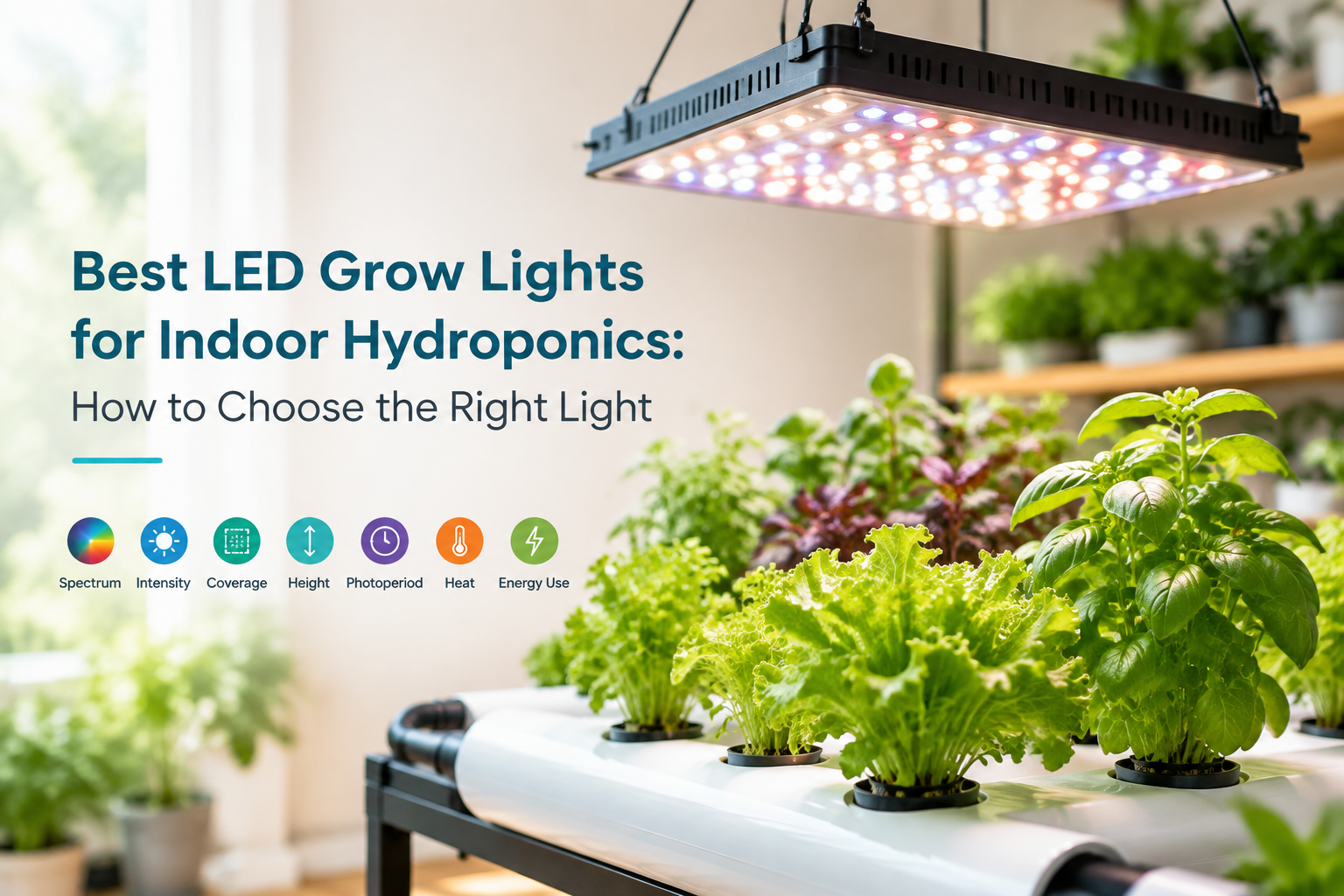
Light is one of the most important environmental factors in an indoor hydroponic garden. Plants use light as the energy source for photosynthesis, so even a well-designed nutrient system can perform poorly if illumination is inadequate.
Choosing an LED grow light can feel confusing because products use different wattage ratings, spectrum descriptions, coverage claims, and technical measurements. Beginners often focus only on the number of watts, but wattage alone does not tell you how effectively the light reaches the plant canopy.
This guide explains the main factors to consider when selecting an LED grow light for hydroponic vegetables and herbs. The goal is not to choose the most powerful light, but to match light intensity and coverage to the crop and growing space.
Why Light Matters in Hydroponics
Outdoor plants receive sunlight from a very large source, while indoor plants depend on artificial lighting. A hydroponic system provides water and nutrients, but it cannot replace the energy plants obtain from light.
Insufficient light can result in stretched stems, slow growth, pale leaves, and weak plants. Excessive light can create stress, increase leaf temperature, and raise electricity use. The ideal setup delivers enough usable light across the growing area without creating unnecessary heat.
The crop also matters. Leafy greens generally require less intense lighting than many fruiting crops. Herbs may sit somewhere in between depending on species and growth stage.
Understand Spectrum
Most modern grow lights are designed to provide a broad spectrum that supports photosynthesis. Full-spectrum LED fixtures are popular because their light is visually comfortable and suitable for many stages of plant growth.
Blue wavelengths are associated with compact vegetative growth, while red wavelengths play important roles in photosynthesis and flowering. In practice, growers do not need to build a complicated spectrum recipe for every crop. A quality broad-spectrum fixture designed for horticulture is often a practical choice for a mixed indoor garden.
Be careful with marketing language. A purple or highly colored light is not automatically more effective than a white-looking horticultural LED. Look at the fixture’s technical information and coverage instead of judging performance by appearance.
Wattage Is Not the Whole Story
A common beginner mistake is choosing a light only because it has a high wattage number. Electrical wattage tells you approximately how much power the fixture consumes, but it does not directly describe how much useful light reaches the leaves.
Look for information about PPFD, PPF, efficacy, and recommended coverage when those specifications are available. PPFD describes the amount of photosynthetically useful light reaching a particular area, while PPF describes the total photosynthetic photon output from the fixture.
For a small hydroponic shelf, an appropriately sized fixture with even coverage can be more useful than an extremely powerful light that creates bright and dark zones.
Coverage and Mounting Height
The size and shape of your growing area should influence your light choice. A fixture designed for a large square canopy may be inefficient over a narrow shelf, while a small lamp may leave the corners of a larger system underlit.
Mounting height also changes the light intensity received by plants. As the light moves farther away, intensity generally decreases. Follow the manufacturer’s recommended hanging height and watch the plants for signs of excessive or insufficient light.
If only the center of the garden grows strongly while plants near the edges struggle, the problem may be uneven coverage rather than insufficient total wattage.
Photoperiod: How Long Should the Light Stay On?
Indoor growers often use a timer to provide a consistent daily light schedule. The appropriate photoperiod depends on the crop, light intensity, growth stage, and overall environment.
More hours are not automatically better. Plants also have biological processes that occur during darkness. Instead of leaving lights on continuously, choose a consistent schedule appropriate for the crop and observe plant response.
A timer is inexpensive and removes one variable from your routine. Consistency is particularly helpful when you are comparing different varieties or recording growth from week to week.
Heat, Ventilation, and Energy Use
LEDs are generally more efficient than many older indoor lighting technologies, but they still produce heat. A light placed in a small enclosed grow area can raise air and leaf temperature.
Ventilation and airflow help manage heat and humidity. Keep the grow space organized so air can move around both the plants and the light fixture. Never cover ventilation openings or place electrical equipment where it can be exposed to water.
Electricity cost is another reason to choose the correct fixture size. A light that is unnecessarily powerful can increase operating expenses without improving plant performance if the crop cannot use the additional intensity.
How to Choose a Light for Different Crops
For leafy greens such as lettuce and many microgreens, prioritize even coverage and moderate intensity. These crops generally do not require the same lighting environment as large fruiting plants.
Herbs such as basil can tolerate and often benefit from stronger lighting, but the exact requirement depends on variety and growing conditions.
For fruiting crops such as tomatoes or peppers, light becomes even more important because the plants must support flowering and fruit production. In that case, look for a fixture specifically intended for a larger canopy and higher-light-demand crops.
Frequently Asked Questions
Are LED grow lights good for hydroponics? Yes. Quality horticultural LEDs are widely used for indoor hydroponic growing.
Can I use a normal household LED bulb? It may provide some useful light, but coverage and intensity may be inadequate for serious indoor production. A horticultural fixture designed for plant growth is usually easier to manage.
How far should an LED grow light be from plants? Follow the manufacturer’s guidance and adjust based on crop response and available light measurements.
Do hydroponic plants need natural sunlight if they have LEDs? Not necessarily. A properly designed indoor setup can provide the artificial light required for growth.
Final Thoughts
The best LED grow light is the one that matches your crop, growing area, and operating conditions. Instead of buying the strongest fixture, compare coverage, light output, efficiency, mounting options, heat management, and manufacturer guidance. Once the light is matched to the garden, your hydroponic system becomes much easier to manage consistently.