
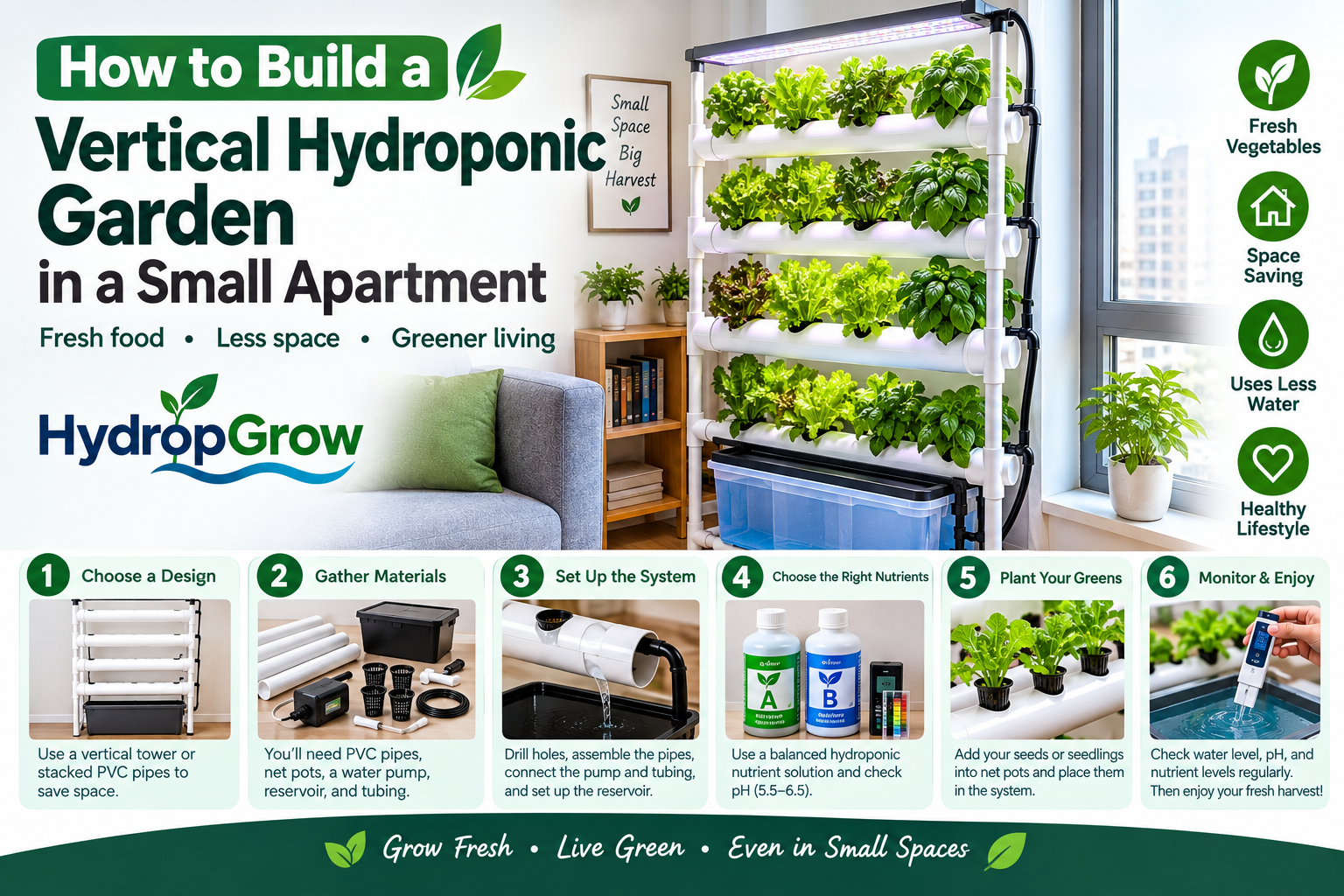
A small apartment does not have to prevent you from growing fresh food. Vertical hydroponic gardening uses height instead of a large floor area, making it useful for balconies, kitchens, spare rooms, and compact indoor growing spaces.
The challenge is not simply stacking plants. A successful vertical system needs even irrigation, enough light at every level, good airflow, stable support, and easy access for maintenance.
This guide explains how to plan a compact vertical hydroponic garden from the ground up, with a focus on leafy greens and herbs that are practical for small spaces.
Choose the Right Location
Start by measuring the available floor area and vertical height. Leave enough space around the system to inspect plants, refill the reservoir, clean equipment, and harvest.
Avoid placing the garden where water can damage furniture, electrical outlets, or flooring. A waterproof tray or suitable protective surface can make maintenance safer.
Consider airflow and access to electricity. Pumps and grow lights need reliable power, and the area should allow air to circulate around the plants.
Choose Crops That Fit Vertical Growing
Leafy greens and herbs are usually easier to manage in a small vertical system than large fruiting plants. Lettuce, basil, mint, parsley, chives, and other compact crops can make good candidates.
Avoid selecting plants only because they are popular. Consider mature size, root volume, light needs, harvest frequency, and whether the plant will shade crops below it.
Start with a few varieties and learn how they behave at different levels of the structure.
Design the Structure
A vertical garden can use stacked channels, towers, shelves, or hanging modules. Choose a structure that can safely support the plants, nutrient solution, reservoir, lighting equipment, and plumbing.
The system should remain stable when fully loaded. Secure tall structures so they cannot tip, especially in homes with children or pets.
Leave enough space between plant sites for foliage to expand. A system that looks efficient when empty can become overcrowded once plants mature.
Plan Irrigation and Drainage
Water must reach every plant consistently. In a vertical system, gravity can cause the upper and lower sections to receive different amounts of nutrient solution if the design is not balanced.
Test the system with clean water before adding plants. Check every outlet and make sure drainage returns safely to the reservoir.
A pump timer can be used in some designs, while others run continuously. Follow the requirements of the specific system and crop.
Lighting Every Level
Lighting is one of the biggest challenges in vertical gardens. Plants at the top may receive more light while lower levels remain shaded.
Use separate fixtures or carefully positioned lighting so that each growing level receives adequate coverage. Avoid relying on one light placed far above the entire structure unless it provides sufficient intensity at every level.
Check plant growth regularly. Stretching at lower levels can be a practical sign that the light distribution needs improvement.
Reservoir and Nutrient Management
A central reservoir simplifies nutrient management in many vertical systems. Use a suitable volume for the number of plants and monitor water level regularly.
Check pH and EC according to your crop and nutrient program. Because many plants share the same solution, one issue can affect the whole system.
Keep the reservoir protected from light and clean it regularly. Remove dead leaves and other debris before they enter the water.
Airflow, Humidity, and Maintenance
Dense vertical gardens can trap humid air between layers. Gentle airflow helps reduce stagnant pockets and supports healthy foliage.
Leave enough room to inspect every plant. If a section is difficult to reach, small problems can go unnoticed until they affect neighboring plants.
Create a simple weekly checklist covering pumps, tubing, reservoir level, pH, EC, light operation, roots, and plant condition. Regular maintenance is easier than emergency repairs.
Common Small-Space Mistakes
One mistake is building the largest possible garden without considering maintenance. A smaller system that is easy to access is often more practical.
Another mistake is underestimating light. Plants may survive under weak light but produce slow, stretched growth.
Overcrowding is also common. Leave enough space for mature foliage and avoid placing fast-growing plants where they will shade slower crops.
Frequently Asked Questions
Is vertical hydroponics good for apartments? Yes, especially for compact crops, provided the system is stable and water is safely contained.
What plants are easiest for a vertical garden? Leafy greens and compact herbs are generally easier than large fruiting plants.
Does a vertical hydroponic system need a pump? Many systems do, but the exact requirement depends on the design. Some passive systems can work without continuous pumping.
How do I prevent water leaks indoors? Test the system before planting, inspect all connections regularly, use appropriate containers and drainage, and protect the surrounding floor or furniture.
Final Thoughts
A vertical hydroponic garden can turn a small unused corner into a productive growing area. The key is to design for maintenance rather than maximum plant count. Choose compact crops, distribute light evenly, test irrigation before planting, and keep the reservoir clean. With a simple layout, even a small apartment can support a useful indoor garden.