
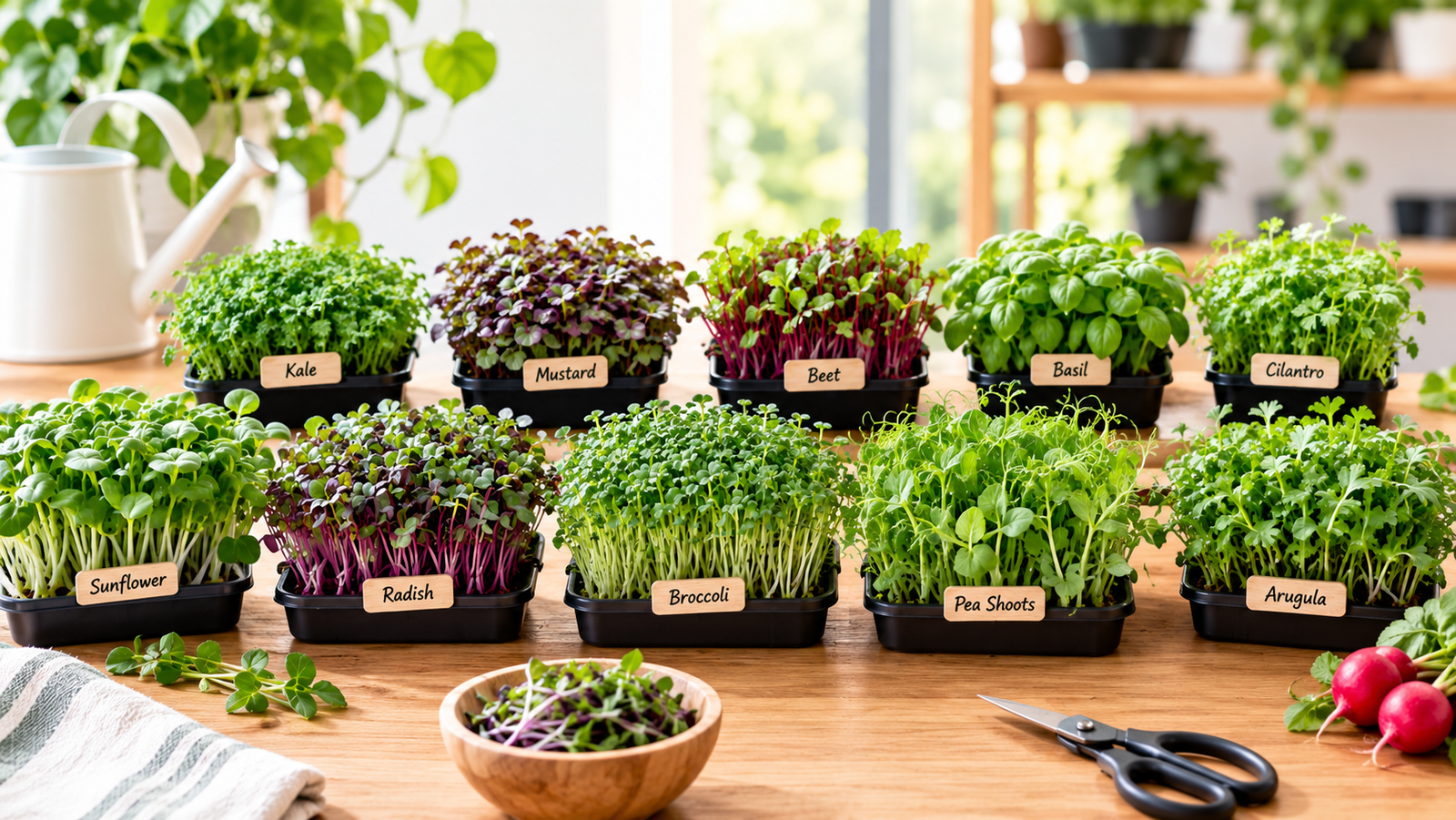
Choosing your first microgreens should be exciting, but the number of available varieties can make the decision difficult.
The best microgreens to grow at home depend on what you want from your harvest. Flavor, growing speed, available space, and how you plan to use the greens in your kitchen all matter.
Some varieties are mild, some spicy, some sweet, and some strongly aromatic. Some grow faster than others.
For beginners, starting with just a few easy varieties is usually a better strategy than planting many different types at once.
What Makes a Good Microgreen for Beginners?
Fast Growth
A short growing cycle lets you see results quickly and learn from your first growing attempt.
Pleasant Flavor
Choose varieties you already enjoy eating.
Simple Growing Requirements
Some crops are more forgiving and easier to manage indoors.
Versatility
The best microgreens can be used across several different meals.
A Simple Strategy for Your First Tray
Instead of growing many varieties immediately, start with two or three that provide contrasting flavors.
The source suggests:
- Broccoli for mild flavor
- Radish for spicy flavor
- Pea shoots for sweet flavor
1. Radish Microgreens
Flavor: Spicy and peppery
Radish microgreens are a strong choice for growers who enjoy bold flavors.
They can add a noticeable kick to salads, sandwiches, wraps, and grain bowls. Brassica crops such as radish also tend to germinate and grow relatively quickly.
Best for: Beginners who enjoy spicy flavors.
2. Broccoli Microgreens
Flavor: Mild
Broccoli microgreens are a popular option for beginners who want an easy variety to incorporate into everyday meals.
Their mild flavor works well in salads, sandwiches, wraps, and other dishes.
Best for: Beginners who prefer mild flavors.
3. Pea Shoots
Flavor: Mild and sweet
Pea shoots are a good option for people who prefer a fresh, sweeter taste.
They can add flavor and texture to salads and sandwiches.
Best for: People who like sweet, fresh greens.
4. Sunflower Microgreens
Flavor: Nutty
Sunflower microgreens are known for their nutty flavor and substantial texture.
They can work particularly well in salads, wraps, and sandwiches.
Best for: Growers looking for a nutty, satisfying microgreen.
5. Arugula Microgreens
Flavor: Peppery
Arugula is a strong option for anyone who enjoys a bold, peppery flavor.
A relatively small amount can add character to salads, sandwiches, pizzas, and other dishes.
Best for: Fans of bold, peppery flavors.
6. Kale Microgreens
Flavor: Mild
Kale is a versatile microgreen that can be easy to combine with other foods.
Its mild flavor makes it useful for beginners looking for an adaptable variety.
Best for: Beginners looking for an adaptable variety.
7. Mustard Microgreens
Flavor: Spicy
Mustard microgreens are a good choice when you want something with more heat.
They can add flavor to salads, sandwiches, wraps, and other meals.
Best for: People who enjoy spicy foods.
8. Beet Microgreens
Flavor: Mild and earthy
Beet microgreens can add both flavor and visual interest to meals.
They are especially interesting for growers who want colorful microgreens.
Best for: Growers who want colorful microgreens.
9. Basil Microgreens
Flavor: Aromatic
Basil can be grown as a microgreen and is particularly interesting for people who enjoy fresh herbs.
The source notes that basil can grow more slowly than many Brassica microgreens, so it may require more patience.
Best for: Herb lovers.
10. Cilantro Microgreens
Flavor: Fresh and herbaceous
Cilantro microgreens are another option for people who enjoy fresh herbs.
They can be used in salads, wraps, grain dishes, and meals where cilantro is already a natural ingredient. Like basil, cilantro can be slower-growing than many Brassica microgreens.
Best for: People who enjoy fresh herbal flavors.
Best Microgreens by Flavor
| Flavor | Microgreens to Try |
|---|---|
| Spicy | Radish, Mustard |
| Mild | Broccoli, Kale |
| Sweet | Pea Shoots |
| Nutty | Sunflower |
| Peppery | Arugula |
| Earthy | Beet |
| Aromatic | Basil, Cilantro |
These flavor groupings follow the article’s source material.
How to Grow the Best Microgreens at Home
Choosing the right variety is only the beginning.
Use a Suitable Growing Medium
A lightweight soilless growing medium works well for indoor microgreens.
Keep the Medium Moist
Water regularly enough to keep the growing medium moist without keeping it saturated.
Provide Enough Light
Microgreens need sufficient light for healthy development. Grow lights can provide more consistent conditions than relying on a window alone.
Maintain Airflow
Good air circulation is particularly useful when growing dense trays indoors.
Harvest at the Right Time
Many microgreens are harvested when their true leaves have expanded and they reach roughly 2–3 inches, although the ideal stage varies by crop.
How Can You Use Microgreens?
One of the best reasons to grow several varieties is their versatility.
Microgreens can be added to:
- Salads
- Sandwiches
- Wraps
- Omelets
- Grain bowls
- Soups
- Burgers
- Pizza
- Dips
- Smoothies
Frequently Asked Questions
What are the easiest microgreens to grow?
Popular beginner options include radish, broccoli, kale, arugula, peas, and sunflower.
What is the fastest-growing microgreen?
Growth speed depends on both the crop and the growing conditions. The source notes that many Brassica-family microgreens, including radish and mustard, tend to grow relatively quickly.
Can I grow microgreens indoors all year?
Yes. They can be grown indoors throughout the year when appropriate growing conditions are provided.
How long do microgreens take to grow?
Many varieties reach harvest size in approximately 7–21 days after sowing, depending on the variety.
Which microgreens taste the best?
Taste is subjective. Mild choices include broccoli and kale, spicy options include radish and mustard, and pea shoots are a good option for sweeter flavors.
Final Thoughts
The best microgreens to grow at home are the ones that match your taste and your growing goals.
For a simple first project, start with radish, broccoli, or pea shoots. Once you’ve become comfortable with watering, lighting, airflow, and harvesting, you can expand into sunflower, arugula, mustard, beet, basil, and cilantro.
Next to read: Learn how to grow microgreens indoors step by step and build a simple growing routine.