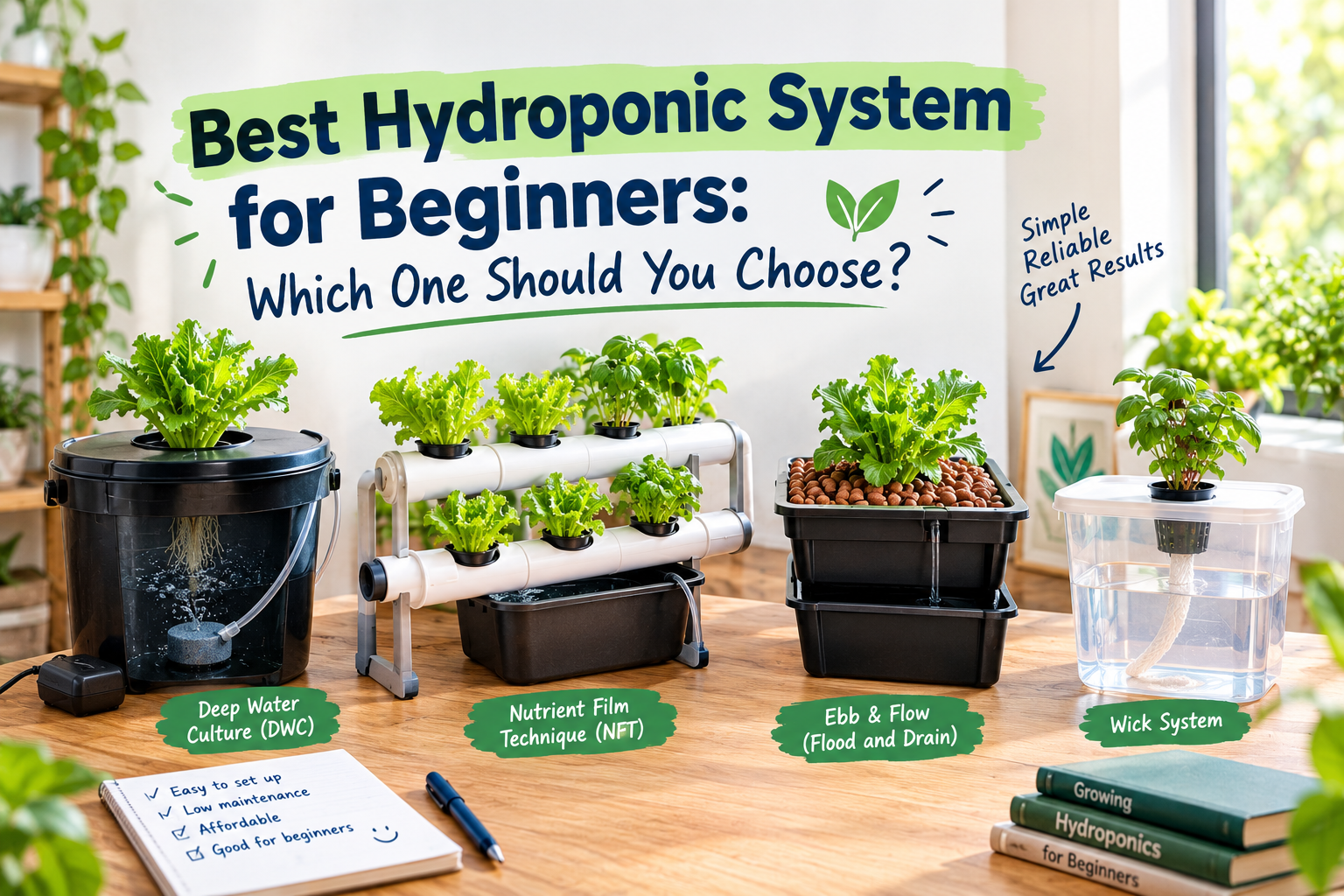
Choosing the best hydroponic system for beginners can be confusing. Deep Water Culture (DWC), the Kratky method, Nutrient Film Technique (NFT), drip hydroponics, and other soilless growing methods all deliver water and mineral nutrients to plant roots, but they do it in different ways. Some systems are inexpensive and simple, while others offer more control at the cost of extra equipment and maintenance.
This guide compares eight popular hydroponic systems: DWC, NFT, Ebb and Flow, Drip Hydroponics, Aeroponics, the Kratky Method, Wick Systems, and Vertical Hydroponics. You will learn how each system works, what it is best for, its main advantages and limitations, and how to choose a beginner hydroponic setup that matches your plants, space, budget, and available time.
Table of Contents
- Hydroponics for Beginners: What Is a Hydroponic System?
- Quick Comparison of 8 Hydroponic Systems
- Deep Water Culture (DWC)
- Nutrient Film Technique (NFT)
- Ebb and Flow (Flood and Drain)
- Drip Hydroponics
- Aeroponics
- The Kratky Method
- Wick Hydroponic Systems
- Vertical Hydroponic Systems
- How to Choose the Best Hydroponic System for Your Needs
- Best Hydroponic Systems for Common Beginner Goals
- Essential Hydroponic Setup and Maintenance Tips
- Common Beginner Mistakes
- Frequently Asked Questions
- Final Recommendation
Hydroponics for Beginners: What Is a Hydroponic System?
Hydroponics is a method of growing plants without traditional soil. Plant roots receive water and essential mineral nutrients from a nutrient solution, sometimes with the support of a growing medium such as coco coir, perlite, clay pebbles, or rockwool. The growing medium helps support the plant or manage moisture; it does not replace the need for suitable nutrition.
A hydroponic system controls how water, nutrients, and oxygen reach the root zone. The design affects how often you must check the plants, what crops are practical, how much equipment you need, and how quickly a problem can affect the crop. Passive systems have fewer mechanical parts, while active systems often rely on pumps, timers, air pumps, or spray nozzles.
There is no single best hydroponic system for every grower. A small apartment grower producing lettuce has different needs from someone growing tomatoes in a greenhouse. The most useful comparison considers crop type, space, budget, maintenance time, electricity, and the consequences of equipment failure.
Quick Comparison of 8 Hydroponic Systems
Use the table below as a starting point. Cost and difficulty are relative estimates; actual requirements depend on system size, materials, lighting, crop, and local prices.
| System | How It Works | Relative Cost | Maintenance | Often Best For |
| DWC | Roots sit in aerated nutrient solution | Low–moderate | Moderate | Lettuce, basil, small active systems |
| NFT | A thin film of solution flows through sloped channels | Moderate | Moderate–high | Leafy greens and herbs in channels |
| Ebb and Flow | A tray is flooded, then drained | Moderate | Moderate | Trays, pots, seedlings, mixed crops |
| Drip Hydroponics | Emitters deliver solution to each plant and medium | Moderate | Moderate | Tomatoes, peppers, cucumbers |
| Aeroponics | Roots receive nutrient solution as spray or mist | Moderate–high | High | Controlled growing and experienced growers |
| Kratky | Plants use a stationary nutrient reservoir and air gap | Low | Low–moderate | Small passive leafy-green grows |
| Wick System | A wick draws solution toward the growing medium | Low | Low | Small plants and simple experiments |
| Vertical Hydroponics | Plants are arranged in stacked or upright growing sites | Varies | Varies | Small spaces and maximizing growing area |
Important distinction: vertical hydroponics describes the layout, not one single water-delivery method. A vertical garden may use drip irrigation, NFT-style channels, or another design. Its performance depends on the irrigation method and how evenly water reaches each level.
1. Deep Water Culture (DWC)
How DWC works
Deep Water Culture, or DWC hydroponics, places plant roots in a reservoir of nutrient solution. Plants are supported by net pots or a raft, and an air pump with an air stone adds oxygen to the water. As the plant grows, roots extend into the reservoir and absorb water and dissolved minerals.
Advantages
- A relatively straightforward system to build and understand.
- A practical way to learn reservoir management, pH, EC, and nutrient mixing.
- Often suitable for lettuce, basil, pak choi, and other compact crops.
Limitations
DWC depends on adequate aeration and suitable water temperature. If the air pump fails or the water becomes too warm, roots may become stressed. The reservoir should block light to discourage algae, and larger plants may require more space and stronger support.
Choose DWC if you want an active but relatively simple system and are willing to check the water and air pump regularly. A small system with a few leafy plants is a sensible first project.
2. Nutrient Film Technique (NFT)
How NFT works
Nutrient Film Technique uses sloped channels through which a shallow stream of nutrient solution flows. Plant roots grow inside the channels, contacting the solution while also having access to air. A pump delivers solution from a reservoir, and the return flow carries it back.
Advantages
- Channels can organize many plants in rows and use growing space efficiently.
- Recirculating solution can reduce the need to discard water, although monitoring remains necessary.
- Often well suited to lettuce, basil, and other leafy greens with manageable root systems.
Limitations
NFT is sensitive to interrupted flow. If a pump stops, roots may dry out quickly because the channels hold relatively little solution. Root buildup, poor slope, blocked outlets, or uneven flow can also cause problems.
NFT may suit beginners who enjoy monitoring equipment and want to grow several leafy plants. Test channel flow and drainage before planting, and plan for pump or power failure.
3. Ebb and Flow (Flood and Drain)
How it works
An ebb and flow hydroponic system periodically pumps nutrient solution into a growing tray and then lets it drain back into a reservoir. During flooding, roots and growing media receive water and nutrients; after drainage, air returns to the root zone.
Advantages
- Can support plants in pots, trays, or blocks of suitable growing media.
- Flexible for herbs, leafy crops, seedlings, and some larger plants.
- Allows growers to adjust the flooding schedule to the crop and growing conditions.
Limitations
The system relies on a pump, timer, and dependable drainage. Poor drainage can leave roots too wet, while pump or timer failure can interrupt watering. Flood depth and cycle timing must suit the medium, crop, temperature, and humidity.
Consider ebb and flow if you want flexibility across several plant types and are comfortable testing the flood-and-drain cycle before adding plants.
4. Drip Hydroponics
How it works
A drip hydroponic system sends nutrient solution from a reservoir through tubing and small emitters to individual plants. The plants usually grow in a substrate such as coco coir, perlite, rockwool, or a suitable mix. Depending on the design, excess solution may be collected and reused or allowed to drain away.
Advantages
- Can deliver water and nutrients to individual plants.
- Works with a range of growing media and container sizes.
- Often practical for larger crops such as tomatoes, peppers, and cucumbers when properly designed.
Limitations
Emitters can clog, tubing can leak, and uneven pressure can lead to uneven irrigation. Filters, regular inspections, and a suitable drainage plan help keep the system reliable. Irrigation frequency must match the crop, medium, container, and climate.
Drip hydroponics is a flexible option for growers who want to raise larger plants or scale up over time. Start with a small number of containers and check every emitter before planting.
5. Aeroponics
How it works
Aeroponics suspends plant roots in an enclosed chamber and delivers nutrient solution as a spray or mist. The roots receive water and minerals while remaining surrounded by air between spray cycles.
Advantages
- Can provide high oxygen availability around the root zone.
- May use water efficiently in a well-designed, well-maintained system.
- Offers a controlled environment for growers interested in more advanced techniques.
Limitations
Aeroponics is equipment-dependent. Nozzles can clog, filters need cleaning, and pumps or controllers can fail. Because suspended roots can dry quickly when spraying stops, reliable equipment and a response plan are essential.
Aeroponics is usually not the easiest first system for someone seeking minimal maintenance. Learn nutrient management and root-zone care with a simpler system before investing in a complex misting setup.
6. The Kratky Method
How it works
The Kratky method is a passive hydroponic technique that does not require a water pump or active circulation. A plant sits above a nutrient reservoir. As the plant takes up water, the solution level falls and an air gap forms, allowing part of the root system to access oxygen.
Advantages
- Few components and no water pump for a basic passive setup.
- Can be inexpensive and quiet for small growing projects.
- Often suitable for a carefully planned batch of lettuce and other leafy greens.
Limitations
Reservoir size, crop choice, nutrient concentration, and water use need to be planned. A container that is too small may not supply enough solution for the whole growing cycle. Refilling without understanding the root air gap can also create problems.
Kratky is a strong option if your priority is simplicity and low equipment cost. Choose a short-cycle leafy crop, use an opaque container, and follow crop-specific instructions.
7. Wick Hydroponic Systems
How it works
A wick system uses absorbent material to draw nutrient solution from a reservoir into the growing medium through capillary action. The system is passive and usually has no water pump. The wick and medium must be able to deliver enough moisture for the plant’s needs.
Advantages
- Simple design with few mechanical parts.
- Quiet and potentially inexpensive for small plants.
- Useful for learning basic soilless growing without a powered irrigation system.
Limitations
Wick systems may not deliver water quickly enough for large or fast-growing plants with high water demand. Wick material, length, growing medium, and evaporation all affect performance. A medium that stays too wet or too dry can limit plant health.
Choose a wick system for small, low-demand plants and simple experiments rather than assuming it will suit every crop. Check moisture and plant growth regularly, especially as plants mature.
8. Vertical Hydroponic Systems
How they work
A vertical hydroponic system arranges growing sites in stacked levels, towers, or upright channels. This layout can make better use of limited floor space. Water may be delivered by drip lines, NFT-style channels, or another irrigation approach, so the vertical layout should be evaluated together with its water-delivery design.
Advantages
- Can increase the number of planting sites in a small footprint.
- May suit balconies, indoor growing areas, and compact greenhouses when light and airflow are adequate.
- Can be paired with different irrigation methods and crops, depending on the design.
Limitations
Plants at different heights may receive different amounts of light or nutrient solution. Upper levels can shade lower plants, and water distribution can be uneven if the system is poorly designed. Tall structures also need stable support, accessible cleaning points, and a reliable drainage path.
Choose vertical hydroponics when floor space is limited, but inspect light distribution, water flow at every level, stability, and maintenance access before scaling the system.
How to Choose the Best Hydroponic System for Your Needs
Start with the crop and your routine, not with the most advanced equipment. The right system should fit your available space, the plants’ root and water needs, your budget, and how often you can inspect the garden.
- For the lowest equipment cost: Kratky or a wick system can be a simple place to start with small, suitable plants. Their passive design reduces the need for powered irrigation equipment.
- For learning active hydroponics: DWC offers a clear introduction to nutrient reservoirs and aeration. It requires regular checks but is relatively easy to understand.
- For rows of leafy greens: NFT may work well if you can maintain reliable flow, channel slope, and clean return lines.
- For tomatoes and peppers: Drip hydroponics is often adaptable because it delivers solution to individual plants growing in a suitable substrate.
- For trays, pots, and mixed crops: Ebb and flow provides flexibility, provided the tray drains correctly and the cycle suits the growing medium.
- For advanced, controlled growing: Aeroponics offers a specialized root environment but requires careful attention to nozzles, filters, and pump reliability.
- For limited floor space: A vertical layout can help, but it must provide adequate light and even irrigation at every level.
Best Hydroponic Systems for Common Beginner Goals
| Your Goal | Systems to Consider | What to Check First |
| Grow a few lettuce plants | Kratky, DWC, NFT | Reservoir size, light, nutrient management |
| Avoid pumps where possible | Kratky, wick | Crop water demand and moisture consistency |
| Grow tomatoes or peppers | Drip hydroponics | Support, substrate, irrigation, light |
| Use trays or multiple pots | Ebb and flow | Flood depth, timer, drainage |
| Grow in a narrow space | Vertical system using a suitable irrigation method | Light at each level, stable structure, even flow |
| Try a more advanced root environment | Aeroponics | Nozzle filtration, pump reliability, backup plan |
Essential Hydroponic Setup and Maintenance Tips
Use appropriate nutrients
Choose a complete hydroponic nutrient product suited to the crop and follow the manufacturer’s directions. More fertilizer does not automatically mean faster growth. Different plants and growth stages may need different nutrient strengths.
Monitor pH and nutrient strength
pH affects nutrient availability. Electrical conductivity (EC) estimates the concentration of dissolved ions and can help you monitor nutrient strength. Appropriate readings depend on the crop and growth stage, so use crop-specific guidance and make adjustments gradually.
Provide enough light and airflow
Indoor plants may need a suitable grow light and ventilation. Insufficient light can lead to weak, stretched growth, while excessive heat can stress plants and warm the nutrient solution. Check that all plants receive suitable light, including those on lower levels of a vertical garden.
Keep the system clean
Use an opaque reservoir where appropriate, keep debris out of tubing and channels, and clean equipment between growing cycles. Inspect roots, water levels, leaks, emitters, filters, pumps, and drains according to the system you use.
Plan for equipment failure
Active systems may depend on electricity, pumps, timers, or nozzles. Understand how quickly your crop could dry out if water delivery stops. Test the system before transplanting and consider spare parts or a backup plan when failure could damage the crop.
Common Beginner Mistakes
- Choosing a system before choosing a crop: Different crops have different root sizes, water demands, and support needs.
- Starting too big: A small system makes it easier to learn and troubleshoot.
- Ignoring pH and nutrient strength: Monitor consistently and avoid making large adjustments based on guesswork.
- Letting light reach the reservoir: Light can encourage algae; opaque containers help keep the solution dark.
- Overlooking irrigation failures: Check pumps, timers, nozzles, channels, and emitters according to your design.
- Assuming every system is low-maintenance: Passive systems still require sensible crop selection and observation.
- Copying a universal schedule: Watering and nutrient requirements vary with crop, climate, medium, and system design.
Frequently Asked Questions
What is the best hydroponic system for beginners?
There is no universal winner. Kratky is a simple passive option for suitable leafy crops; DWC is a useful active system for learning reservoir and aeration management. The best choice depends on your crop, space, budget, and maintenance routine.
Which hydroponic system is the cheapest?
Small Kratky and wick systems often have the lowest equipment requirements because they can operate without a water pump. The total cost still depends on containers, nutrients, lighting, and the crop.
Is DWC better than Kratky?
Not in every situation. DWC uses aeration and requires powered equipment, while Kratky is passive. DWC can suit growers who want to manage an active reservoir; Kratky can suit small, planned grows with fewer components.
Is NFT good for beginners?
It can be, especially for leafy greens, but the system depends on reliable flow. Pump failure, blocked channels, and poor drainage can quickly affect roots.
Which hydroponic system is best for tomatoes?
Drip hydroponics is often a flexible choice for tomatoes when paired with a suitable substrate, strong light, plant support, and a well-managed nutrient program.
Does vertical hydroponics mean a separate growing method?
Vertical hydroponics mainly describes the layout. It can use different water-delivery methods, so both the structure and irrigation design need to be considered.
Do all hydroponic systems need electricity?
No. Basic Kratky and wick systems can operate without a powered water pump. Many active systems use pumps, aeration, timers, or spray equipment, and indoor gardens may also need grow lights.
Do hydroponic plants still need nutrients?
Yes. Hydroponic plants need essential mineral nutrients in appropriate proportions, even though they grow without traditional soil.
Final Recommendation
For many first-time growers, a small Kratky setup with lettuce is an accessible way to try hydroponics without buying a pump. If you want to learn active hydroponic management, DWC is a practical starting point. Choose NFT when you can maintain continuous flow, drip hydroponics for flexible irrigation of larger crops, and ebb and flow for tray-based growing. Wick systems suit small, low-demand plants; vertical systems are useful when space is limited; and aeroponics is better suited to growers prepared to maintain more sensitive equipment.
The best hydroponic system for beginners is the one that matches your crop and that you can maintain consistently. Start small, provide adequate light, use appropriate nutrients, monitor pH and EC when possible, and keep a simple record of plant growth and system checks. Expand only after your first setup is working reliably.