
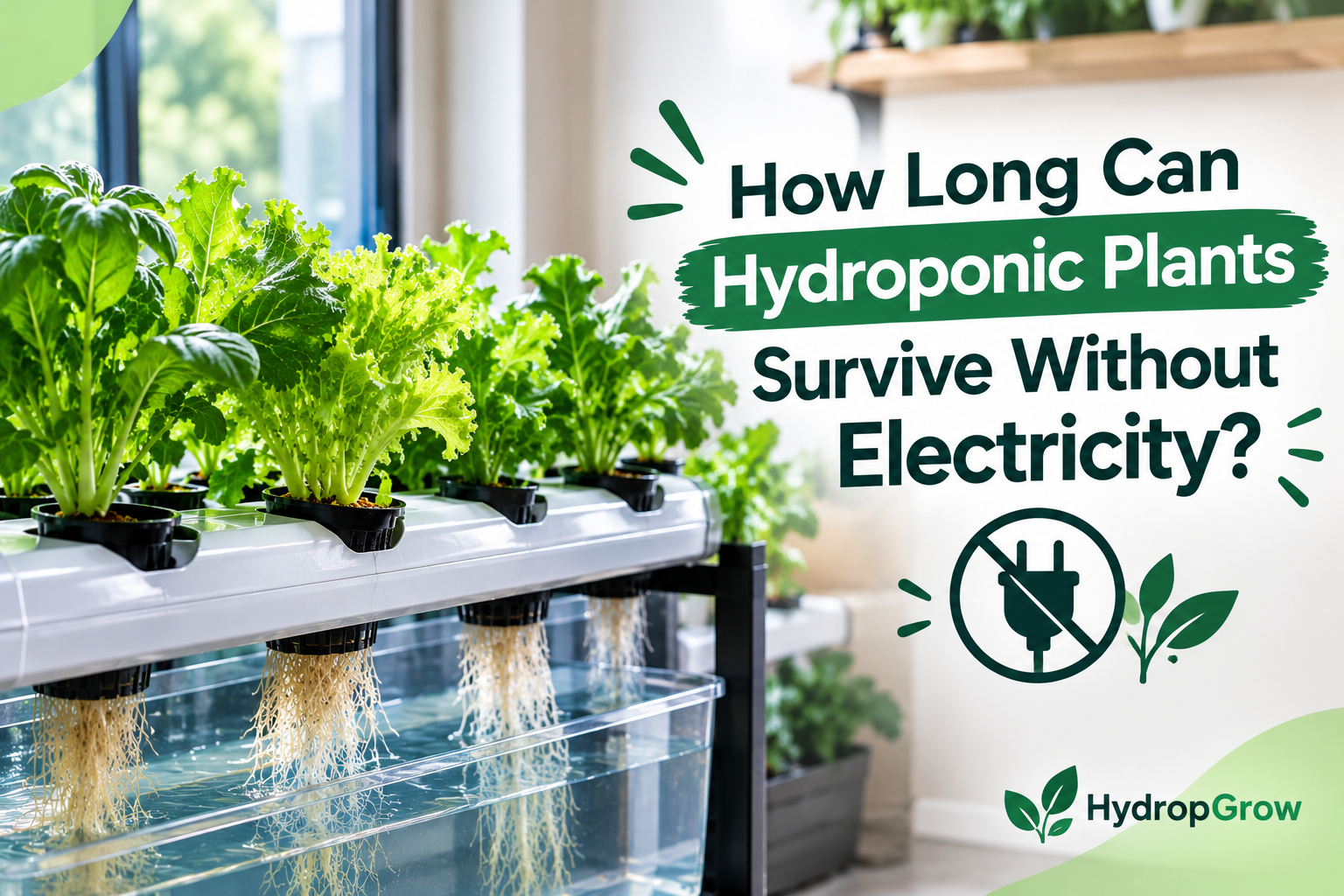
There is no single number of hours that guarantees a hydroponic plant will survive without electricity. A wick system may continue functioning because it does not need a powered pump, while an NFT garden can become vulnerable much sooner if nutrient solution stops flowing. DWC plants remain surrounded by solution, but oxygenation can fall when aeration stops. Temperature, plant size, reservoir volume, humidity, and the condition of the root zone all change the answer.
Table of Contents
- Why This Topic Matters
- What You Need Before You Start
- Understanding Hydroponic Systems
- Step-by-Step Guide
- Light, Water, Nutrients and Environment
- Common Mistakes to Avoid
- Troubleshooting
- Maintenance and Recovery
- Frequently Asked Questions
- Topic-Specific Questions
- Internal Linking Opportunities
- Final Tips
Why This Topic Matters
Knowing the limits of a hydroponic system helps a grower decide whether a simple manual backup is enough or whether a battery, generator, or second pump is justified. The important distinction is between systems that can continue delivering moisture passively and systems that require continuous powered movement of nutrient solution.
What You Need Before You Start
- A system-specific emergency plan
- Backup power for the most critical pump or air pump
- A clean container for temporary manual watering
- A thermometer
- pH and EC testing equipment
- Spare pump tubing and fittings
- A written record of normal reservoir conditions
Understanding Hydroponic Systems
Passive Systems
Because moisture can move without a powered pump, these systems may continue operating during an outage. Their limitation is that the growing method still has to provide adequate moisture, oxygen, and nutrients.
DWC
The solution remains available to the roots, but dissolved oxygen can become the main concern when aeration stops. Warm water holds less oxygen, so temperature matters.
NFT
The survival window can be short compared with passive systems because the roots normally depend on a continuous film of nutrient solution.
Ebb and flow
The interval since the last flood and the water-holding capacity of the growing medium influence how quickly roots become stressed.
The best setup is the one that matches the crop, available space, expected maintenance, and the grower’s ability to monitor the system. A simpler design is often easier to troubleshoot because fewer components can fail at the same time.
Step-by-Step Guide
1. Classify your system
Write down whether your garden is passive, DWC, NFT, ebb and flow, or another active design. This determines what stops when electricity stops.
2. List every powered function
Separate circulation, aeration, lighting, fans, heaters, and climate control. Not every device has the same priority.
3. Estimate the critical window
Instead of relying on a generic survival time, consider how quickly your roots can lose access to water or oxygen under your actual conditions.
4. Prepare a manual method
Keep clean equipment available for temporary watering or aeration where appropriate. Emergency procedures should be simple enough to use under stress.
5. Monitor temperature
Warm conditions increase the pressure on the system because plants transpire more and warm water carries less dissolved oxygen.
6. Restore normal operation
Once power returns, check that pumps and timers are operating correctly and verify the reservoir before resuming the normal routine.
Light, Water, Nutrients and Environment
Survival without electricity is strongly connected to the root environment. A plant does not suddenly become independent of water, oxygen, light, and temperature just because the power is off. Indoor gardens can also lose ventilation, which changes humidity and temperature. The most useful approach is to identify which environmental variable becomes limiting first in the particular system.
Light
Light should be managed according to the crop and the growing location. Indoor growers should distinguish between a room that looks bright and a location that provides enough usable light for photosynthesis. Outdoor or window gardens also need protection from excessive heat.
Water and Oxygen
Water availability and root-zone oxygen are connected to system design. Active circulation, aeration, reservoir temperature, and the amount of exposed root surface all influence the root environment. Do not treat water quantity alone as proof that roots are healthy.
Nutrients and pH
Use a complete hydroponic nutrient program appropriate for the crop. Measure the solution rather than making repeated adjustments based only on appearance. pH and EC are useful management tools, but they should be interpreted together with plant growth and water conditions.
Common Mistakes to Avoid
- Using a universal survival-hour number for every crop and system
- Ignoring water temperature
- Assuming DWC automatically means the roots have enough oxygen
- Waiting until plants wilt before preparing a backup
- Using a large generator without considering safe operation
Troubleshooting
Rapid wilting
Look first at water access and circulation. In active systems, a stopped pump may be the direct cause.
Roots remain submerged but plants decline
Check aeration and dissolved oxygen conditions, especially if the reservoir is warm.
Reservoir temperature rises
Improve safe environmental control and avoid adding heat to the growing area.
Power returns but plants still struggle
Inspect pumps, tubing, timers, and air stones. The outage may have exposed a component that failed to restart.
Maintenance and Recovery
Once normal conditions are restored, harvest according to the crop rather than forcing an early harvest simply because an outage occurred. Remove only clearly damaged tissue and continue observing new growth.
A good maintenance routine is preventive. Check the root zone, reservoir level, equipment, plant structure, and growing environment at regular intervals. Record unusual observations so you can identify patterns instead of treating every problem as a new mystery.
Frequently Asked Questions
How many hours can hydroponic plants survive without power?
There is no reliable universal number. The answer depends on the system, crop, temperature, root exposure, and which powered functions have stopped.
Do all hydroponic systems need electricity?
No. Passive wick systems can operate without powered circulation, while many active systems use pumps or aeration.
Is oxygen or water more important during an outage?
The limiting factor depends on the system. NFT may quickly lose flowing water, while DWC can retain water but lose aeration.
Should I use a generator for a home hydroponic garden?
A generator can be part of a backup strategy, but it must be selected and operated safely. For a small garden, a targeted battery backup may be simpler for critical equipment.
Topic-Specific Questions
Small leafy crops often recover differently from large fruiting crops. A mature fruiting plant may have a large canopy and high water demand, while a young seedling has a smaller root system but can still be vulnerable to drying. Treat crop stage as part of the emergency calculation.
When applying this advice to a specific crop, consider plant age, canopy size, root volume, and the crop’s preferred environmental conditions. A young herb and a mature fruiting plant can respond very differently to the same change in water, temperature, or light.
Practical Takeaway
The most reliable hydroponic routine is based on observation and measurement. Keep the system stable, learn what is normal for your crop, and investigate changes before making large corrections. This approach makes hydroponics more predictable and easier to maintain over time.
Internal Linking Opportunities
- What Happens to Hydroponic Plants When the Power Goes Out?
- Can You Run a Hydroponic Garden Without a Water Pump?
- Can Hydroponics Work During a Heatwave?
Final Tips
- Match the hydroponic method to the crop and the level of maintenance you can provide.
- Measure important variables instead of relying only on visual symptoms.
- Keep equipment clean and inspect pumps, tubing, reservoirs, and timers regularly.
- Make one controlled change at a time when troubleshooting.
- Record useful observations so future problems are easier to diagnose.