
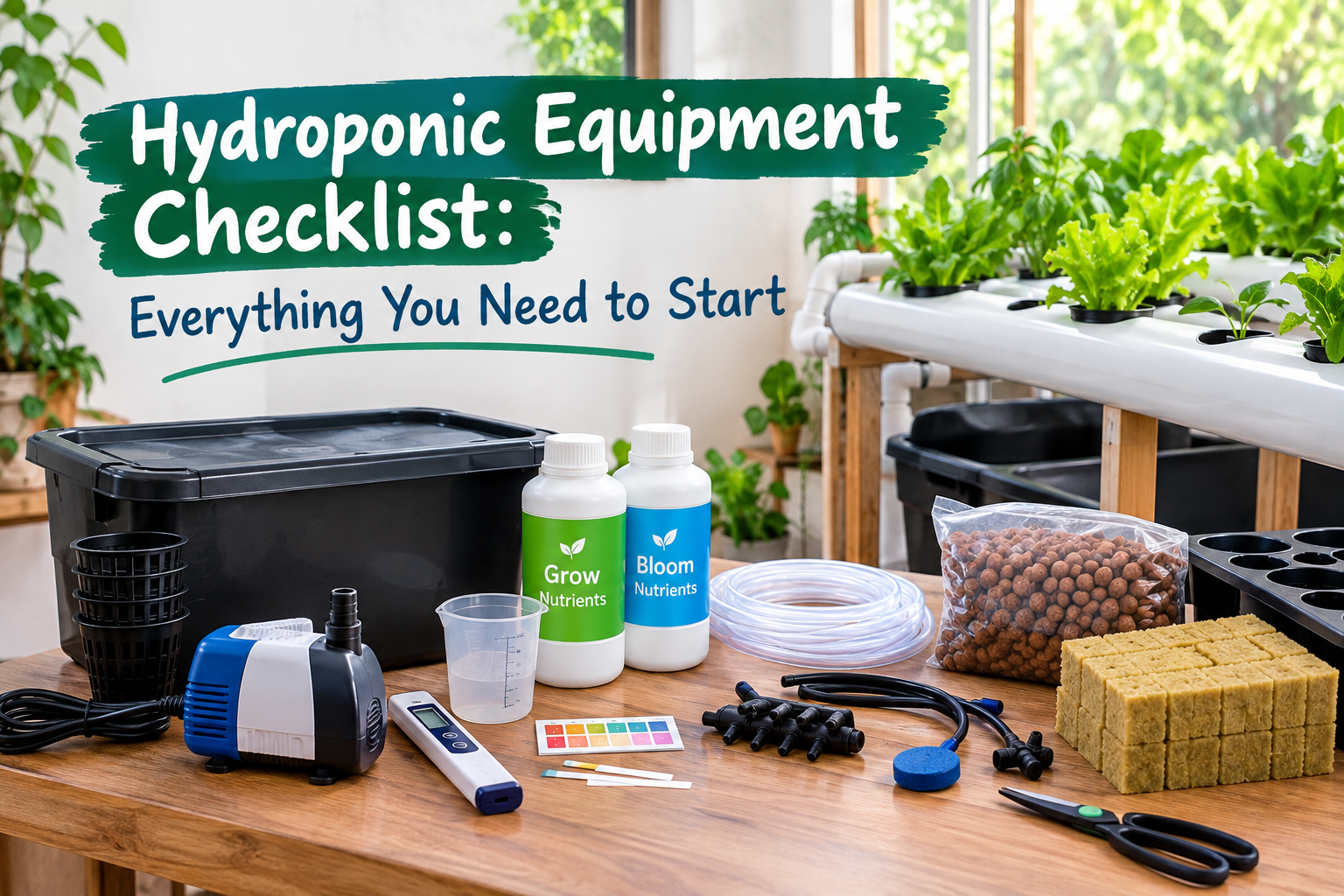
Starting a hydroponic garden does not require a complicated setup. The key is understanding what each piece of equipment does, which items are essential, and which upgrades can wait until you have more experience. This guide walks through the complete hydroponic equipment checklist for beginners, from the growing system and reservoir to lighting, nutrients, water testing, air pumps, grow media, ventilation, and useful accessories.
Table of Contents
- What Equipment Do You Need for Hydroponics?
- Choosing Your Hydroponic System
- Reservoir, Container, and Growing Tray
- Net Pots and Grow Media
- Hydroponic Nutrients
- pH Meter, EC Meter, and Water Testing
- Air Pump, Air Stone, and Oxygenation
- Water Pump, Tubing, and Irrigation Parts
- Grow Lights for Indoor Hydroponics
- Ventilation, Fans, and Environmental Control
- Seeds, Seed Starting, and Plant Support
- Timers, Automation, and Electrical Safety
- Cleaning, Maintenance, and Replacement Supplies
- Optional Hydroponic Equipment and Upgrades
- Beginner Hydroponic Setup: A Simple Shopping List
- Hydroponic Equipment Checklist
- Common Equipment Mistakes to Avoid
- Final Thoughts
What Equipment Do You Need for Hydroponics?
Hydroponic gardening basics
Hydroponics is a method of growing plants without traditional soil. Instead of relying on soil to store water and nutrients, the grower provides the plant with water, mineral nutrients, oxygen, light, and physical support. This makes the equipment you choose especially important: each component has a specific job in the growing environment.
Essential equipment vs. optional equipment
A beginner hydroponic garden can be surprisingly simple. In most setups, you need a hydroponic system or suitable container, a reservoir, a way to hold the plant, growing media when required, hydroponic nutrients, water, and a method of providing enough light. Indoor growers usually also need a grow light and airflow.
A practical approach
Do not buy every hydroponic accessory at once. Start with the equipment required by your chosen system, learn how your plants respond, and add upgrades when a real need appears. This approach keeps the initial cost under control and makes troubleshooting much easier.
Choosing Your Hydroponic System
Deep Water Culture (DWC)
DWC is one of the easiest hydroponic systems for beginners. Plant roots sit in nutrient solution while an air pump and air stone add oxygen. A bucket, net pot, suitable growing medium, nutrient solution, and air pump can be enough for a small DWC setup.
Kratky method
The Kratky method is a passive hydroponic technique that can work without a water pump or air pump. As the nutrient solution level falls, an air gap develops around the roots. It is attractive for beginners because it has fewer moving parts and requires little equipment.
Nutrient Film Technique (NFT)
NFT continuously moves a shallow film of nutrient solution through channels. It is efficient and well suited to leafy greens, but it depends on reliable water circulation. A pump, tubing, channels, reservoir, and backup plan for power interruptions are important.
Drip hydroponics
Drip systems deliver nutrient solution to plants through small irrigation lines and emitters. They can support many plant types and are useful when you want precise irrigation. The main equipment includes a reservoir, water pump, tubing, drip lines, emitters, and often a timer.
Ebb and Flow
Ebb and flow, also called flood and drain, periodically floods the growing area with nutrient solution and then drains it back into the reservoir. It normally requires a pump, timer, reservoir, tray, tubing, and suitable growing media.
Aeroponics and vertical systems
Aeroponic systems suspend roots and spray them with nutrient-rich mist, while vertical hydroponic systems arrange growing sites upward to save space. These systems can be productive, but they may require more precise equipment and maintenance than a basic beginner setup.
Reservoir, Container, and Growing Tray
The reservoir
The reservoir holds the nutrient solution. Choose an opaque, food-safe container when possible because light entering the solution can encourage algae growth. The reservoir should be large enough to provide stable water conditions without becoming unnecessarily difficult to clean.
Size and access
A small home system may use a bucket or storage container, while larger gardens use dedicated reservoirs. Easy access matters because you will need to inspect water level, check temperature, adjust nutrients, and clean the container.
Growing tray and support
Flood-and-drain and some drip systems use a growing tray above the reservoir. Make sure the tray is stable and that drainage is reliable. A poorly supported tray can cause leaks or uneven irrigation.
Net Pots and Grow Media
Net pots
Net pots hold plants while allowing roots to grow through openings. Select a size appropriate for the plant and system. Net pots are common in DWC, NFT, and many other hydroponic configurations.
Popular growing media
Common hydroponic growing media include clay pebbles, rockwool, coco coir, perlite, vermiculite, and specialized plugs. The right choice depends on the hydroponic system, crop, moisture requirements, and your preferred handling method.
What good media should do
A useful growing medium provides physical support while maintaining an appropriate balance of moisture and air around the roots. It should not introduce unwanted contaminants and should be compatible with the system you are building.
Hydroponic Nutrients
Why nutrients matter
Plants still need essential mineral elements when grown without soil. Hydroponic nutrients supply elements such as nitrogen, phosphorus, potassium, calcium, magnesium, and sulfur, along with required micronutrients.
Choosing nutrients
Beginners should generally choose a complete hydroponic nutrient formula designed for the crop or growth stage. Follow the manufacturer’s mixing instructions rather than assuming that a stronger solution will produce faster growth. Overfeeding can damage roots and create nutrient imbalance.
Mixing nutrient solution
Start with clean water, then add nutrients according to the product instructions. Measure rather than guessing. After mixing, check electrical conductivity (EC) or total dissolved solids (TDS) if your system uses those measurements, and monitor plant response over time.
Do not forget water quality
Source water can contain minerals that affect nutrient concentration and pH. If your tap water is very hard or inconsistent, testing the source water can help explain recurring problems. A water filter may be useful in some situations, but it is not automatically necessary for every garden.
pH Meter, EC Meter, and Water Testing
pH meter
pH describes how acidic or alkaline the nutrient solution is. A suitable pH range helps plants access nutrients effectively. The ideal range varies by crop and system, so use a reliable horticultural reference rather than treating one number as universal.
EC meter
EC, or electrical conductivity, estimates the concentration of dissolved ions in the nutrient solution. It is one of the most useful measurements for hydroponic growers because it helps you monitor nutrient strength and detect changes as plants consume water and nutrients.
TDS meter
TDS meters are commonly marketed to hydroponic growers, but they estimate dissolved solids from conductivity rather than directly measuring every nutrient. For consistent nutrient management, understand whether your target recommendations are expressed as EC or a particular TDS conversion scale.
Calibration and maintenance
A cheap meter that is poorly calibrated can create expensive problems. Calibrate pH meters according to their instructions, keep probes clean, store them correctly, and replace calibration solutions when needed. Rinse probes with appropriate clean water between measurements.
Air Pump, Air Stone, and Oxygenation
Why dissolved oxygen matters
Roots require oxygen for healthy respiration. In systems where roots remain submerged, such as DWC, active aeration is particularly important. An air pump pushes air through tubing and an air stone, producing bubbles that increase gas exchange at the water surface.
Choosing an air pump
Select a pump rated for the volume and depth of your system. For multiple buckets or reservoirs, a manifold can distribute air to several air stones. Keep the pump positioned safely and prevent water from flowing backward into the pump with suitable tubing arrangements or a check valve.
Air stones
Air stones create smaller bubbles and improve contact between air and water. They eventually collect mineral deposits or become less effective, so inspect and clean or replace them when necessary.
Water Pump, Tubing, and Irrigation Parts
Water pump
A water pump is essential for NFT, ebb and flow, and many drip systems. Pump selection depends on flow rate, lifting height, tubing resistance, and the design of the system. A pump that is too weak may fail to deliver enough solution; one that is unnecessarily powerful can create unwanted flow or waste energy.
Tubing and fittings
Use tubing that matches your pump, emitters, channels, and connectors. Check every connection for leaks before adding plants. Simple fittings, valves, clamps, and elbows can make a system much easier to adjust and maintain.
Drippers and irrigation
Drip systems need emitters or drip lines that deliver solution consistently. Clogged emitters are a common problem, especially when nutrients, particles, or algae enter the irrigation lines. Filtration and routine inspection can reduce failures.
Grow Lights for Indoor Hydroponics
Why lighting is essential
Plants need adequate light for photosynthesis. If your hydroponic garden is indoors or receives insufficient sunlight, a grow light becomes one of the most important pieces of equipment.
LED grow lights
LED grow lights are popular for indoor hydroponics because they can provide strong plant-usable light with relatively efficient electricity use and limited radiant heat compared with some older lighting technologies. Choose a light based on the growing area and the crop rather than simply buying the highest wattage available.
Light intensity and coverage
Pay attention to coverage area, hanging height, dimming capability, and manufacturer information about PPFD when available. Leafy greens and fruiting crops can have different light requirements. A light that is excellent for a small lettuce shelf may be inadequate for a larger tomato canopy.
Light schedule
A timer can automate the daily light cycle. Plants need both light and darkness, so avoid leaving grow lights on continuously unless a specific crop-management strategy justifies it. Follow the needs of your crop and maintain a consistent schedule.
Ventilation, Fans, and Environmental Control
Air circulation
A small oscillating or clip fan helps move air around leaves, reduces stagnant pockets, and supports a more uniform growing environment. Good air movement is particularly useful indoors.
Exhaust and ventilation
For enclosed grow spaces, an exhaust fan can remove warm, humid air and bring in fresh air. Grow tents often combine an inline fan, ducting, and a suitable intake arrangement.
Temperature and humidity
A digital thermometer and hygrometer are inexpensive but valuable. Tracking temperature and relative humidity helps you understand why plants may be stressed, transpiring too quickly, or developing environmental problems.
Grow tent
A grow tent can help create a controlled indoor growing area and manage light. It is optional for a simple windowsill or open-room setup, but useful when you want a dedicated environment for hydroponic plants.
Seeds, Seed Starting, and Plant Support
Seeds and propagation
Start with healthy seeds suited to your environment. Germination can be done in plugs, rockwool, coco-based media, or another suitable starter medium. Keep seedlings adequately moist and provide appropriate light as soon as they emerge.
Seedling support
Young plants need stable support before their roots are large enough to anchor themselves. Net pots and starter plugs make transplanting easier, especially when moving seedlings into DWC or other systems.
Trellises and plant support
Large plants such as tomatoes, cucumbers, and peppers may require trellis netting, stakes, clips, or string. Planning support before the canopy becomes heavy prevents damage later.
Timers, Automation, and Electrical Safety
Timers
Timers are useful for grow lights, water pumps, and other equipment that should operate on a schedule. Automation reduces repetitive tasks and makes environmental routines more consistent.
Automation upgrades
More advanced systems can add automatic dosing, water-level monitoring, environmental sensors, smart controllers, and automated irrigation. These upgrades can save time, but they also add cost and potential points of failure.
Electrical safety
Water and electricity require special care. Keep plugs, power strips, and controllers away from spills and standing water. Use appropriate electrical protection, create drip loops where applicable, and inspect cords regularly. Never use damaged electrical equipment around a hydroponic reservoir.
Cleaning, Maintenance, and Replacement Supplies
Cleaning supplies
A hydroponic system should be cleaned regularly to reduce algae, biofilm, mineral deposits, and other buildup. Keep separate cleaning tools for the garden and rinse components thoroughly after cleaning according to the materials involved.
Spare parts
Keep a few inexpensive replacement parts available: extra tubing, connectors, air stones, net pots, pump fittings, and spare timers when appropriate. A small spare-parts box can prevent a minor failure from becoming a major interruption.
Monitoring routine
Check water level, pH, EC, temperature, root condition, leaks, pump operation, and plant appearance on a consistent schedule. Preventive maintenance is easier than trying to rescue a neglected system.
Optional Hydroponic Equipment and Upgrades
Water chiller
A water chiller can help maintain nutrient-solution temperature in warm environments, especially in systems where roots remain submerged. It is not normally required for a basic beginner garden.
Water filtration
Filtration can be useful when source water contains unwanted particles or when water quality makes nutrient management difficult. Choose filtration based on an actual water-quality problem rather than buying it automatically.
CO2 supplementation
CO2 equipment is an advanced option and is not necessary for most beginner hydroponic gardens. Before considering it, make sure light, nutrients, temperature, humidity, airflow, and plant health are already well managed.
pH dosing and controllers
Automatic pH dosing can reduce manual adjustments in larger or more demanding systems. However, automation should supplement good monitoring rather than replace understanding of the nutrient solution.
Beginner Hydroponic Setup: A Simple Shopping List
Low-cost DWC setup
For a simple DWC garden, a beginner can start with an opaque bucket or reservoir, one net pot, suitable growing media, an air pump, air stone, airline tubing, hydroponic nutrients, a pH meter or test kit, seeds or seedlings, and an appropriate grow light if growing indoors. A timer and thermometer are useful additions.
Small indoor leafy-green setup
For lettuce, basil, herbs, or similar crops, focus on reliable lighting, a suitable hydroponic system, clean water, balanced nutrients, root support, airflow, and basic pH/EC monitoring. You do not need advanced automation to learn the fundamentals.
Larger fruiting-crop setup
Tomatoes, cucumbers, and peppers need more space, stronger structural support, higher light levels, and careful irrigation. Plan the reservoir, pump, lighting, trellis, ventilation, and electrical layout before installing the plants.
Budget principle
Spend first on equipment that directly affects plant health: a suitable system, dependable lighting when needed, good nutrient management, oxygenation or circulation as required, and accurate basic measurements. Decorative accessories and advanced automation can come later.
Hydroponic Equipment Checklist
Core checklist
- Hydroponic system or suitable growing container
- Reservoir or nutrient container
- Net pots or plant holders
- Suitable growing media
- Hydroponic nutrients
- Clean water
- pH meter or reliable pH test kit
- EC meter when appropriate
- Air pump and air stone for aerated systems
- Water pump for circulating systems
- Tubing and fittings
- Grow light for indoor growing
- Timer
- Fan for air circulation
- Thermometer/hygrometer
- Seeds or healthy seedlings
- Plant support for larger crops
- Cleaning supplies
- Spare tubing and basic replacement parts
Before you buy
Confirm that every component is compatible with your system. A Kratky setup does not need the same equipment as NFT. A DWC bucket does not require a water pump for circulation, but it normally needs active aeration. A drip system needs irrigation components that match the pump and layout.
Common Equipment Mistakes to Avoid
Buying too much equipment
One of the most common beginner mistakes is purchasing advanced equipment before understanding the basics. Start with a manageable system and learn how water, nutrients, roots, light, and airflow interact.
Ignoring measurement accuracy
A poor pH or EC reading can lead to unnecessary adjustments. Choose reliable meters, calibrate them, and learn how to interpret readings instead of reacting to every small change.
Choosing equipment by wattage alone
For grow lights, electrical wattage does not tell the entire story. Coverage, efficiency, PPFD, hanging height, spectrum, and heat output all matter.
No backup plan
A pump failure can quickly affect systems that depend on continuous circulation or aeration. Keeping basic spare parts and checking equipment regularly can reduce downtime.
Poor layout
Crowded tubing, unstable reservoirs, inaccessible electrical connections, and difficult-to-clean components make maintenance harder. Design the system so you can inspect and clean it easily.
Final Thoughts
Build the right system, not the biggest system
The best hydroponic equipment checklist is the one that matches your plants, space, budget, and hydroponic method. Beginners usually benefit more from a simple, reliable setup than from a highly automated garden they do not yet understand.
A smart path forward
Start with the essentials, monitor your plants, and upgrade when you identify a genuine limitation. Once you understand your system, equipment such as better grow lights, environmental controllers, water filtration, dosing systems, or additional circulation can make sense.
Keep learning
Hydroponics becomes much easier when you understand the relationship between light, roots, oxygen, water, nutrients, pH, EC, temperature, and airflow. Use this checklist as a starting point, then adapt your equipment to the crop and system you choose.